

How Many Domesticated Animals Are There In The World

Dogs and sheep were amidst the kickoff animals to be domesticated.
The domestication of animals is the mutual relationship between animals and the humans who accept influence on their care and reproduction.[i]
Charles Darwin recognized a pocket-size number of traits that made domesticated species different from their wild ancestors. He was also the showtime to recognize the difference between conscious selective breeding in which humans directly select for desirable traits, and unconscious pick where traits evolve as a by-product of natural option or from option on other traits.[2] [3] [4] There is a genetic difference betwixt domestic and wild populations. There is besides a genetic departure between the domestication traits that researchers believe to take been essential at the early on stages of domestication, and the comeback traits that have appeared since the divide between wild and domestic populations.[v] [6] [vii] Domestication traits are generally fixed inside all domesticates, and were selected during the initial episode of domestication of that animal or plant, whereas improvement traits are present only in a proportion of domesticates, though they may be fixed in individual breeds or regional populations.[6] [7] [8]
Domestication should not be confused with taming. Taming is the conditioned behavioral modification of a wild-born animal when its natural avoidance of humans is reduced and it accepts the presence of humans, merely domestication is the permanent genetic modification of a bred lineage that leads to an inherited predisposition toward humans.[9] [ten] [eleven] Certain animal species, and sure individuals inside those species, brand better candidates for domestication than others because they showroom certain behavioral characteristics: (1) the size and organization of their social construction; (2) the availability and the caste of selectivity in their option of mates; (3) the ease and speed with which the parents bond with their young, and the maturity and mobility of the young at birth; (4) the caste of flexibility in diet and habitat tolerance; and (five) responses to humans and new environments, including flight responses and reactivity to external stimuli.[12] : Fig 1 [thirteen] [14] [15]
Information technology is proposed that there were 3 major pathways that well-nigh animal domesticates followed into domestication: (1) commensals, adapted to a human niche (e.grand., dogs, cats, fowl, maybe pigs); (ii) prey animals sought for food (e.g., sheep, goats, cattle, h2o buffalo, yak, pig, reindeer, llama, alpaca, and turkey); and (iii) targeted animals for draft and nonfood resources (e.thousand., horse, donkey, camel).[vii] [12] [16] [17] [xviii] [nineteen] [xx] [21] [22] The domestic dog was the first to be domesticated,[23] [24] and was established across Eurasia before the end of the Late Pleistocene era, well before tillage and before the domestication of other animals.[23] Unlike other domestic species which were primarily selected for product-related traits, dogs were initially selected for their behaviors.[25] [26] The archaeological and genetic information suggest that long-term bidirectional cistron menstruum betwixt wild and domestic stocks – including donkeys, horses, New and Old World camelids, goats, sheep, and pigs – was mutual.[7] [17] I study has ended that human selection for domestic traits likely counteracted the homogenizing effect of gene flow from wild boars into pigs and created domestication islands in the genome. The same process may too apply to other domesticated animals. Some of the nearly commonly domesticated animals are cats and dogs.[27] [28]
Definitions [edit]
Domestication [edit]
Domestication has been defined as "a sustained multi-generational, mutualistic human relationship in which ane organism assumes a significant caste of influence over the reproduction and care of another organism in order to secure a more anticipated supply of a resource of interest, and through which the partner organism gains reward over individuals that remain exterior this relationship, thereby benefitting and often increasing the fitness of both the domesticator and the target domesticate."[1] [12] [29] [30] [31] This definition recognizes both the biological and the cultural components of the domestication process and the furnishings on both humans and the domesticated animals and plants. All past definitions of domestication take included a relationship between humans with plants and animals, but their differences lay in who was considered every bit the pb partner in the relationship. This new definition recognizes a mutualistic relationship in which both partners proceeds benefits. Domestication has vastly enhanced the reproductive output of crop plants, livestock, and pets far beyond that of their wild progenitors. Domesticates have provided humans with resources that they could more predictably and securely control, move, and redistribute, which has been the reward that had fueled a population explosion of the agro-pastoralists and their spread to all corners of the planet.[12]
This biological mutualism is non restricted to humans with domestic crops and livestock but is well-documented in nonhuman species, peculiarly among a number of social insect domesticators and their plant and beast domesticates, for example the ant–mucus mutualism that exists betwixt leafcutter ants and certain fungi.[i]
Domestication syndrome [edit]
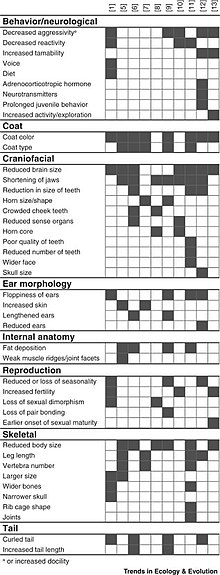
Traits used to ascertain the creature domestication syndrome[32]
Domestication syndrome is a term often used to draw the suite of phenotypic traits arising during domestication that distinguish crops from their wild ancestors.[five] [33] The term is besides applied to animals and includes increased docility and tameness, coat colour changes, reductions in tooth size, changes in craniofacial morphology, alterations in ear and tail form (e.g., floppy ears), more frequent and nonseasonal oestrus cycles, alterations in adrenocorticotropic hormone levels, changed concentrations of several neurotransmitters, prolongations in juvenile behavior, and reductions in both total brain size and of particular brain regions.[34] The ready of traits used to ascertain the beast domestication syndrome is inconsistent.[32]
Difference from taming [edit]
Domestication should not be confused with taming. Taming is the conditioned behavioral modification of a wild-built-in animate being when its natural abstention of humans is reduced and it accepts the presence of humans, but domestication is the permanent genetic modification of a bred lineage that leads to an inherited predisposition toward humans.[9] [10] [xi] Human being selection included tameness, but without a suitable evolutionary response then domestication was non achieved.[7] Domestic animals need non exist tame in the behavioral sense, such as the Castilian fighting bull. Wildlife tin be tame, such as a hand-raised cheetah. A domestic animal's convenance is controlled past humans and its tameness and tolerance of humans is genetically determined. However, an animal merely bred in captivity is not necessarily domesticated. Tigers, gorillas, and polar bears breed readily in captivity but are non domesticated.[x] Asian elephants are wild animals that with taming manifest outward signs of domestication, yet their breeding is not human being controlled and thus they are not true domesticates.[10] [35]
History, cause and timing [edit]

Development of temperatures in the postglacial catamenia, later the Last Glacial Maximum, showing very low temperatures for the about role of the Younger Dryas, chop-chop rising afterwards to accomplish the level of the warm Holocene, based on Greenland water ice cores.[36]
The domestication of animals and plants was triggered by the climatic and environmental changes that occurred subsequently the top of the Terminal Glacial Maximum around 21,000 years agone and which continue to this nowadays day. These changes made obtaining food difficult. The starting time domesticate was the domestic canis familiaris (Canis lupus familiaris) from a wolf ancestor (Canis lupus) at least fifteen,000 years ago. The Younger Dryas that occurred 12,900 years agone was a catamenia of intense cold and dehydration that put force per unit area on humans to intensify their foraging strategies. Past the beginning of the Holocene from 11,700 years ago, favorable climatic conditions and increasing human being populations led to small-scale-scale animal and institute domestication, which allowed humans to augment the food that they were obtaining through hunter-gathering.[37]
The increased use of agriculture and connected domestication of species during the Neolithic transition marked the first of a rapid shift in the evolution, ecology, and demography of both humans and numerous species of animals and plants.[38] [7] Areas with increasing agronomics, underwent urbanisation,[38] [39] developing higher-density populations,[38] [40] expanded economies, and became centers of livestock and crop domestication.[38] [41] [42] Such agronomical societies emerged across Eurasia, North Africa, and S and Central America.
In the Fertile Crescent 10,000-11,000 years ago, zooarchaeology indicates that goats, pigs, sheep, and taurine cattle were the first livestock to be domesticated. Archaeologists working in Cyprus found an older burial footing, approximately 9500 years old, of an adult man with a feline skeleton.[43] Two thousand years later on, humped zebu cattle were domesticated in what is today Baluchistan in Islamic republic of pakistan. In E Asia 8,000 years ago, pigs were domesticated from wild boar that were genetically different from those found in the Fertile Crescent. The horse was domesticated on the Cardinal Asian steppe 5,500 years agone. The chicken in Southeast Asia was domesticated iv,000 years ago.[37]
Universal features [edit]
The biomass of wild vertebrates is at present increasingly small compared to the biomass of domestic animals, with the calculated biomass of domestic cattle alone existence greater than that of all wild mammals.[44] Because the evolution of domestic animals is ongoing, the process of domestication has a get-go but not an finish. Various criteria take been established to provide a definition of domestic animals, but all decisions about exactly when an animal can be labelled "domesticated" in the zoological sense are arbitrary, although potentially useful.[45] Domestication is a fluid and nonlinear process that may starting time, stop, reverse, or go down unexpected paths with no clear or universal threshold that separates the wild from the domestic. However, there are universal features held in common by all domesticated animals.[12]
Behavioral preadaption [edit]
Sure animal species, and certain individuals within those species, brand better candidates for domestication than others because they exhibit certain behavioral characteristics: (one) the size and system of their social construction; (2) the availability and the degree of selectivity in their selection of mates; (3) the ease and speed with which the parents bond with their young, and the maturity and mobility of the young at birth; (4) the caste of flexibility in diet and habitat tolerance; and (five) responses to humans and new environments, including flight responses and reactivity to external stimuli.[12] : Fig one [thirteen] [14] [15] Reduced wariness to humans and low reactivity to both humans and other external stimuli are a key pre-accommodation for domestication, and these behaviors are besides the chief target of the selective pressures experienced by the animal undergoing domestication.[vii] [12] This implies that not all animals can be domesticated, e.thou. a wild member of the horse family, the zebra.[seven] [42]
Jared Diamond in his book Guns, Germs, and Steel enquired as to why, among the globe'due south 148 large wild terrestrial herbivorous mammals, only 14 were domesticated, and proposed that their wild ancestors must accept possessed six characteristics before they could be considered for domestication:[three] : p168-174

Hereford cattle, domesticated for beef production.
- Efficient diet – Animals that tin efficiently process what they eat and live off plants are less expensive to continue in captivity. Carnivores feed on flesh, which would crave the domesticators to enhance boosted animals to feed the carnivores and therefore increment the consumption of plants further.
- Quick growth rate – Fast maturity rate compared to the human life span allows breeding intervention and makes the fauna useful within an acceptable duration of caretaking. Some large animals require many years before they accomplish a useful size.
- Ability to breed in captivity – Animals that will non breed in captivity are limited to acquisition through capture in the wild.
- Pleasant disposition – Animals with nasty dispositions are unsafe to keep around humans.
- Tendency not to panic – Some species are nervous, fast, and prone to flight when they perceive a threat.
- Social structure – All species of domesticated large mammals had wild ancestors that lived in herds with a dominance bureaucracy amongst the herd members, and the herds had overlapping abode territories rather than mutually exclusive dwelling territories. This arrangement allows humans to take control of the dominance hierarchy.
Brain size and function [edit]

Reduction in skull size with neoteny - grey wolf and chihuahua skulls
The sustained choice for lowered reactivity among mammal domesticates has resulted in profound changes in encephalon form and function. The larger the size of the brain to brainstorm with and the greater its caste of folding, the greater the degree of brain-size reduction nether domestication.[12] [46] Foxes that had been selectively bred for tameness over 40 years had experienced a significant reduction in cranial height and width and past inference in encephalon size,[12] [47] which supports the hypothesis that encephalon-size reduction is an early response to the selective pressure for tameness and lowered reactivity that is the universal feature of brute domestication.[12] The most affected portion of the brain in domestic mammals is the limbic organisation, which in domestic dogs, pigs, and sheep show a twoscore% reduction in size compared with their wild species. This portion of the brain regulates endocrine function that influences behaviors such as assailment, wariness, and responses to environmentally induced stress, all attributes which are dramatically affected by domestication.[12] [46]
Pleiotropy [edit]
A putative cause for the broad changes seen in domestication syndrome is pleiotropy. Pleiotropy occurs when one factor influences two or more seemingly unrelated phenotypic traits. Certain physiological changes characterize domestic animals of many species. These changes include extensive white markings (particularly on the caput), floppy ears, and curly tails. These arise even when tameness is the only trait under selective pressure.[48] The genes involved in tameness are largely unknown, and so it is non known how or to what extent pleiotropy contributes to domestication syndrome. Tameness may be acquired past the downward regulation of fear and stress responses via reduction of the adrenal glands.[48] Based on this, the pleiotropy hypotheses can be separated into ii theories. The Neural Crest Hypothesis relates adrenal gland office to deficits in neural crest cells during development. The Single Genetic Regulatory Network Hypothesis claims that genetic changes in upstream regulators impact downstream systems.[49] [fifty]
Neural crest cells (NCC) are vertebrate embryonic stalk cells that function direct and indirectly during early embryogenesis to produce many tissue types.[49] Because the traits commonly affected by domestication syndrome are all derived from NCC in development, the neural crest hypothesis suggests that deficits in these cells cause the domain of phenotypes seen in domestication syndrome.[50] These deficits could cause changes we see to many domestic mammals, such as lopped ears (seen in rabbit, dog, fox, pig, sheep, goat, cattle, and donkeys) every bit well as curly tails (pigs, foxes, and dogs). Although they do not affect the development of the adrenal cortex directly, the neural crest cells may be involved in relevant upstream embryological interactions.[49] Furthermore, artificial selection targeting tameness may affect genes that control the concentration or movement of NCCs in the embryo, leading to a variety of phenotypes.[50]
The single genetic regulatory network hypothesis proposes that domestication syndrome results from mutations in genes that regulate the expression blueprint of more downstream genes.[48] For example piebald, or spotted coat coloration, may be caused by a linkage in the biochemical pathways of melanins involved in glaze coloration and neurotransmitters such as dopamine that help shape behavior and cognition.[12] [51] These linked traits may arise from mutations in a few cardinal regulatory genes.[12] A problem with this hypothesis is that it proposes that at that place are mutations in gene networks that cause dramatic effects that are not lethal, however no currently known genetic regulatory networks cause such dramatic change in so many different traits.[49]
Limited reversion [edit]
Feral mammals such as dogs, cats, goats, donkeys, pigs, and ferrets that take lived autonomously from humans for generations prove no sign of regaining the brain mass of their wild progenitors.[12] [52] Dingos have lived autonomously from humans for thousands of years simply notwithstanding have the same brain size as that of a domestic canis familiaris.[12] [53] Feral dogs that actively avert human contact are all the same dependent on homo waste for survival and accept not reverted to the self-sustaining behaviors of their wolf ancestors.[12] [54]
Categories [edit]
Domestication can be considered as the terminal phase of intensification in the relationship between brute or establish sub-populations and human societies, but it is divided into several grades of intensification.[55] For studies in creature domestication, researchers have proposed five distinct categories: wild, captive wild, domestic, cross-breeds and feral.[15] [56] [57]
- Wild animals
- Subject field to natural selection, although the action of by demographic events and bogus selection induced past game management or habitat devastation cannot be excluded.[57]
- Convict wild animals
- Directly affected by a relaxation of natural option associated with feeding, breeding and protection/solitude by humans, and an intensification of artificial choice through passive selection for animals that are more suited to captivity.[57]
- Domestic animals
- Subject to intensified artificial selection through husbandry practices with relaxation of natural selection associated with captivity and management.[57]
- Cross-breed animals
- Genetic hybrids of wild and domestic parents. They may be forms intermediate betwixt both parents, forms more than like to one parent than the other, or unique forms distinct from both parents. Hybrids tin be intentionally bred for specific characteristics or can ascend unintentionally equally the result of contact with wild individuals.[57]
- Feral animals
- Domesticates that have returned to a wild state. As such, they experience relaxed artificial selection induced by the captive surround paired with intensified natural pick induced past the wild habitat.[57]
In 2015, a study compared the diverseness of dental size, shape and allometry beyond the proposed domestication categories of modern pigs (genus Sus). The study showed clear differences betwixt the dental phenotypes of wild, captive wild, domestic, and hybrid pig populations, which supported the proposed categories through physical testify. The study did not cover feral sus scrofa populations but called for further research to be undertaken on them, and on the genetic differences with hybrid pigs.[57]
Pathways [edit]
Since 2012, a multi-stage model of animal domestication has been accustomed by ii groups. The first group proposed that animal domestication proceeded along a continuum of stages from anthropophily, commensalism, command in the wild, control of convict animals, extensive breeding, intensive convenance, and finally to pets in a wearisome, gradually intensifying relationship between humans and animals.[45] [55]
The second group proposed that at that place were iii major pathways that most creature domesticates followed into domestication: (1) commensals, adjusted to a human being niche (e.g., dogs, cats, fowl, possibly pigs); (two) prey animals sought for nutrient (due east.g., sheep, goats, cattle, water buffalo, yak, hog, reindeer, llama and alpaca); and (3) targeted animals for draft and nonfood resource (east.thousand., equus caballus, donkey, camel).[seven] [12] [sixteen] [17] [xviii] [19] [20] [21] [22] The beginnings of animal domestication involved a protracted coevolutionary process with multiple stages along different pathways. Humans did non intend to domesticate animals from, or at least they did non envision a domesticated animal resulting from, either the commensal or prey pathways. In both of these cases, humans became entangled with these species as the human relationship betwixt them, and the human being office in their survival and reproduction, intensified.[7] Although the directed pathway proceeded from capture to taming, the other two pathways are not equally goal-oriented and archaeological records suggest that they take place over much longer fourth dimension frames.[45]
Commensal pathway [edit]
The commensal pathway was traveled by vertebrates that fed on turn down around human habitats or by animals that preyed on other animals drawn to human camps. Those animals established a commensal relationship with humans in which the animals benefited but the humans received no harm simply little benefit. Those animals that were most capable of taking advantage of the resources associated with human camps would have been the tamer, less aggressive individuals with shorter fight or flight distances.[58] [59] [60] Later, these animals developed closer social or economic bonds with humans that led to a domestic human relationship.[7] [12] [16] The spring from a synanthropic population to a domestic one could only have taken place afterward the animals had progressed from anthropophily to habituation, to commensalism and partnership, when the human relationship betwixt animate being and homo would have laid the foundation for domestication, including captivity and human-controlled convenance. From this perspective, animate being domestication is a coevolutionary process in which a population responds to selective pressure while adapting to a novel niche that included another species with evolving behaviors.[7] Commensal pathway animals include dogs, cats, fowl, and possibly pigs.[23]
The domestication of animals commenced over 15,000 years before present (YBP), offset with the grey wolf (Canis lupus) past nomadic hunter-gatherers. Information technology was not until 11,000 YBP that people living in the About E entered into relationships with wild populations of aurochs, boar, sheep, and goats. A domestication procedure then began to develop. The grey wolf most likely followed the commensal pathway to domestication. When, where, and how many times wolves may accept been domesticated remains debated considering only a pocket-sized number of ancient specimens accept been found, and both archaeology and genetics continue to provide conflicting evidence. The nigh widely accepted, earliest dog remains date dorsum 15,000 YBP to the Bonn–Oberkassel domestic dog. Earlier remains dating dorsum to xxx,000 YBP take been described as Paleolithic dogs, all the same their status as dogs or wolves remains debated. Recent studies signal that a genetic divergence occurred betwixt dogs and wolves 20,000–twoscore,000 YBP, however this is the upper time-limit for domestication considering it represents the time of divergence and not the time of domestication.[61]
The craven is one of the most widespread domesticated species and one of the homo earth's largest sources of protein. Although the craven was domesticated in S-Eastern asia, archaeological evidence suggests that it was not kept as a livestock species until 400 BCE in the Levant.[62] Prior to this, chickens had been associated with humans for thousands of years and kept for cock-fighting, rituals, and majestic zoos, and so they were not originally a prey species.[62] [63] The chicken was not a popular food in Europe until only ane thousand years ago.[64]
Prey pathway [edit]
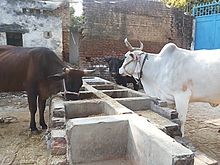
Domesticated dairy cows in North India
The prey pathway was the way in which nearly major livestock species entered into domestication as these were in one case hunted by humans for their meat. Domestication was probable initiated when humans began to experiment with hunting strategies designed to increment the availability of these prey, perhaps as a response to localized pressure level on the supply of the animal. Over time and with the more responsive species, these game-management strategies developed into herd-management strategies that included the sustained multi-generational command over the animals' movement, feeding, and reproduction. As human interference in the life-cycles of casualty animals intensified, the evolutionary pressures for a lack of aggression would take led to an conquering of the same domestication syndrome traits found in the commensal domesticates.[7] [12] [sixteen]
Prey pathway animals include sheep, goats, cattle, h2o buffalo, yak, grunter, reindeer, llama and alpaca. The correct conditions for the domestication for some of them appear to take been in place in the central and eastern Fertile Crescent at the finish of the Younger Dryas climatic downturn and the beginning of the Early on Holocene most xi,700 YBP, and by 10,000 YBP people were preferentially killing immature males of a variety of species and allowed the females to live in order to produce more offspring.[vii] [12] By measuring the size, sex ratios, and mortality profiles of zooarchaeological specimens, archeologists accept been able to document changes in the management strategies of hunted sheep, goats, pigs, and cows in the Fertile Crescent starting eleven,700 YBP. A recent demographic and metrical study of moo-cow and pig remains at Sha'ar Hagolan, Israel, demonstrated that both species were severely overhunted before domestication, suggesting that the intensive exploitation led to management strategies adopted throughout the region that ultimately led to the domestication of these populations following the prey pathway. This pattern of overhunting before domestication suggests that the casualty pathway was as accidental and unintentional as the commensal pathway.[vii] [sixteen]
Directed pathway [edit]

Kazakh shepherd with horse and dogs. Their job is to guard the sheep from predators.
The directed pathway was a more than deliberate and directed process initiated past humans with the goal of domesticating a gratis-living brute. It probably simply came into being one time people were familiar with either commensal or prey-pathway domesticated animals. These animals were likely not to possess many of the behavioral preadaptions some species show before domestication. Therefore, the domestication of these animals requires more deliberate endeavor by humans to piece of work around behaviors that exercise non aid domestication, with increased technological assistance needed.[7] [12] [sixteen]
Humans were already reliant on domestic plants and animals when they imagined the domestic versions of wild animals. Although horses, donkeys, and Onetime World camels were sometimes hunted as prey species, they were each deliberately brought into the man niche for sources of send. Domestication was still a multi-generational accommodation to man selection pressures, including tameness, but without a suitable evolutionary response and then domestication was non achieved.[seven] For instance, despite the fact that hunters of the Near Eastern gazelle in the Epipaleolithic avoided culling reproductive females to promote population balance, neither gazelles[seven] [42] nor zebras[7] [65] possessed the necessary prerequisites and were never domesticated. At that place is no clear show for the domestication of any herded casualty animate being in Africa,[7] with the notable exception of the ass, which was domesticated in Northeast Africa sometime in the fourth millennium BCE.[66]
Multiple pathways [edit]
The pathways that animals may have followed are not mutually exclusive. Pigs, for case, may accept been domesticated as their populations became accustomed to the man niche, which would suggest a commensal pathway, or they may have been hunted and followed a prey pathway, or both.[7] [12] [16]
Postal service-domestication factor flow [edit]
Every bit agricultural societies migrated away from the domestication centers taking their domestic partners with them, they encountered populations of wildlife of the same or sister species. Considering domestics often shared a recent common ancestor with the wild populations, they were capable of producing fertile offspring. Domestic populations were pocket-sized relative to the surrounding wild populations, and repeated hybridizations between the two eventually led to the domestic population becoming more than genetically divergent from its original domestic source population.[45] [67]
Advances in Deoxyribonucleic acid sequencing applied science allow the nuclear genome to be accessed and analyzed in a population genetics framework. The increased resolution of nuclear sequences has demonstrated that cistron menstruation is mutual, not only between geographically various domestic populations of the same species simply also between domestic populations and wild species that never gave rising to a domestic population.[7]
- The yellow leg trait possessed by numerous modernistic commercial chicken breeds was caused via introgression from the grayness junglefowl indigenous to Southward Asia.[seven] [68]
- African cattle are hybrids that possess both a European Taurine cattle maternal mitochondrial betoken and an Asian Indicine cattle paternal Y-chromosome signature.[vii] [69]
- Numerous other bovid species, including bison, yak, banteng, and gaur besides hybridize with ease.[vii] [seventy]
- Cats[7] [71] and horses[vii] [72] have been shown to hybridize with many closely related species.
- Domestic love bees take mated with and then many different species they now possess genomes more variable than their original wild progenitors.[7] [73]
The archaeological and genetic information suggests that long-term bidirectional gene catamenia betwixt wild and domestic stocks – including canids, donkeys, horses, New and Erstwhile World camelids, goats, sheep, and pigs – was common.[vii] [17] Bidirectional gene flow between domestic and wild reindeer continues today.[7]
The consequence of this introgression is that modern domestic populations can ofttimes appear to have much greater genomic analogousness to wild populations that were never involved in the original domestication process. Therefore, it is proposed that the term "domestication" should be reserved solely for the initial process of domestication of a discrete population in fourth dimension and space. Subsequent admixture between introduced domestic populations and local wild populations that were never domesticated should exist referred to as "introgressive capture". Conflating these two processes muddles our understanding of the original process and tin lead to an artificial aggrandizement of the number of times domestication took place.[7] [45] This introgression can, in some cases, exist regarded every bit adaptive introgression, as observed in domestic sheep due to gene flow with the wild European Mouflon.[74]
The sustained admixture between dissimilar dog and wolf populations across the Old and New Worlds over at least the last 10,000 years has blurred the genetic signatures and confounded efforts of researchers at pinpointing the origins of dogs.[23] None of the modern wolf populations are related to the Pleistocene wolves that were first domesticated,[7] [75] and the extinction of the wolves that were the direct ancestors of dogs has muddied efforts to pinpoint the fourth dimension and identify of dog domestication.[seven]
Positive selection [edit]
Charles Darwin recognized the minor number of traits that made domestic species dissimilar from their wild ancestors. He was also the first to recognize the difference betwixt conscious selective breeding in which humans straight select for desirable traits, and unconscious selection where traits evolve equally a by-product of natural selection or from choice on other traits.[ii] [three] [four]
Domestic animals have variations in glaze colour and craniofacial morphology, reduced brain size, floppy ears, and changes in the endocrine organisation and their reproductive cycle. The domesticated argent fox experiment demonstrated that selection for tameness inside a few generations tin issue in modified behavioral, morphological, and physiological traits.[38] [45] In addition to demonstrating that domestic phenotypic traits could arise through choice for a behavioral trait, and domestic behavioral traits could ascend through the selection for a phenotypic trait, these experiments provided a mechanism to explain how the animate being domestication procedure could accept begun without deliberate human forethought and action.[45] In the 1980s, a researcher used a prepare of behavioral, cognitive, and visible phenotypic markers, such as coat colour, to produce domesticated dormant deer within a few generations.[45] [76] Similar results for tameness and fear have been plant for mink[77] and Japanese quail.[78]

Pig herding in fog, Armenia. Man selection for domestic traits is non afflicted past afterwards gene flow from wild boar.[27] [28]
The genetic difference betwixt domestic and wild populations can be framed within two considerations. The first distinguishes between domestication traits that are presumed to have been essential at the early stages of domestication, and improvement traits that have appeared since the dissever between wild and domestic populations.[5] [half-dozen] [vii] Domestication traits are generally stock-still within all domesticates and were selected during the initial episode of domestication, whereas improvement traits are present simply in a proportion of domesticates, though they may exist stock-still in individual breeds or regional populations.[6] [7] [eight] A second issue is whether traits associated with the domestication syndrome resulted from a relaxation of option as animals exited the wild environment or from positive option resulting from intentional and unintentional human being preference. Some recent genomic studies on the genetic basis of traits associated with the domestication syndrome have shed calorie-free on both of these issues.[7]
Geneticists accept identified more than 300 genetic loci and 150 genes associated with coat color variability.[45] [79] Knowing the mutations associated with unlike colors has allowed some correlation between the timing of the appearance of variable coat colors in horses with the timing of their domestication.[45] [fourscore] Other studies have shown how homo-induced selection is responsible for the allelic variation in pigs.[45] [81] Together, these insights suggest that, although natural selection has kept variation to a minimum before domestication, humans have actively selected for novel coat colors as presently as they appeared in managed populations.[45] [51]
In 2015, a report looked at over 100 pig genome sequences to ascertain their procedure of domestication. The process of domestication was assumed to have been initiated by humans, involved few individuals and relied on reproductive isolation between wild and domestic forms, but the study establish that the assumption of reproductive isolation with population bottlenecks was not supported. The report indicated that pigs were domesticated separately in Western asia and Cathay, with Western Asian pigs introduced into Europe where they crossed with wild boar. A model that fitted the information included admixture with a now extinct ghost population of wild pigs during the Pleistocene. The study also constitute that despite back-crossing with wild pigs, the genomes of domestic pigs accept strong signatures of pick at genetic loci that affect behavior and morphology. The study concluded that homo option for domestic traits probable counteracted the homogenizing consequence of cistron flow from wild boars and created domestication islands in the genome. The same procedure may as well apply to other domesticated animals.[27] [28]
Different other domestic species which were primarily selected for product-related traits, dogs were initially selected for their behaviors.[25] [26] In 2016, a study constitute that in that location were only 11 stock-still genes that showed variation betwixt wolves and dogs. These gene variations were unlikely to have been the result of natural evolution, and indicate selection on both morphology and behavior during canis familiaris domestication. These genes accept been shown to bear upon the catecholamine synthesis pathway, with the majority of the genes affecting the fight-or-flying response[26] [82] (i.east. pick for tameness), and emotional processing.[26] Dogs generally show reduced fear and aggression compared to wolves.[26] [83] Some of these genes have been associated with aggression in some dog breeds, indicating their importance in both the initial domestication and and so afterwards in breed formation.[26]
Encounter as well [edit]
- List of domesticated animals
- Hybrid (biological science)#Examples of hybrid animals and animate being populations derived from hybrid
- Landrace
References [edit]
- ^ a b c Zeder, M. A. (2015). "Core questions in domestication Research". Proceedings of the National University of Sciences of the United states of America. 112 (xi): 3191–3198. Bibcode:2015PNAS..112.3191Z. doi:x.1073/pnas.1501711112. PMC4371924. PMID 25713127.
- ^ a b Darwin, Charles (1868). The Variation of Animals and Plants Under Domestication. London: John Murray. OCLC 156100686.
- ^ a b c Diamond, Jared (1997). Guns, Germs, and Steel. London: Chatto and Windus. ISBN978-0-09-930278-0.
- ^ a b Larson, Thousand.; Piperno, D. R.; Allaby, R. G.; Purugganan, K. D.; Andersson, L.; Approach-Kalin, M.; Barton, 50.; Climer Vigueira, C.; Denham, T.; Dobney, K.; Doust, A. Due north.; Gepts, Paul; Gilbert, Grand. T. P.; Gremillion, Thou. J.; Lucas, L.; Lukens, 50.; Marshall, F. B.; Olsen, Yard. M.; Pires, J. C.; Richerson, P. J.; Rubio De Casas, R.; Sanjur, O. I.; Thomas, One thousand. G.; Fuller, D. Q. (2014). "Electric current perspectives and the future of domestication studies". Proceedings of the National Academy of Sciences. 111 (17): 6139–6146. Bibcode:2014PNAS..111.6139L. doi:x.1073/pnas.1323964111. PMC4035915. PMID 24757054.
- ^ a b c Olsen, K. M.; Wendel, J. F. (2013). "A bountiful harvest: genomic insights into ingather domestication phenotypes". Annual Review of Plant Biology. 64: 47–lxx. doi:x.1146/annurev-arplant-050312-120048. PMID 23451788.
- ^ a b c d Doust, A. Northward.; Lukens, L.; Olsen, K. Thousand.; Mauro-Herrera, M.; Meyer, A.; Rogers, K. (2014). "Beyond the single gene: How epistasis and cistron-by-environment furnishings influence crop domestication". Proceedings of the National Academy of Sciences. 111 (17): 6178–6183. Bibcode:2014PNAS..111.6178D. doi:10.1073/pnas.1308940110. PMC4035984. PMID 24753598.
- ^ a b c d e f g h i j k fifty chiliad due north o p q r s t u five w 10 y z aa ab ac ad ae af ag ah ai aj Larson, Grand. (2014). "The Development of Animal Domestication" (PDF). Annual Review of Ecology, Evolution, and Systematics. 45: 115–36. doi:10.1146/annurev-ecolsys-110512-135813.
- ^ a b Meyer, Rachel S.; Purugganan, Michael D. (2013). "Evolution of crop species: Genetics of domestication and diversification". Nature Reviews Genetics. fourteen (12): 840–52. doi:10.1038/nrg3605. PMID 24240513. S2CID 529535.
- ^ a b Toll, Edward O. (2008). Principles and Applications of Domestic Animal Behavior: An Introductory Text. Cambridge University Press. ISBN9781780640556 . Retrieved January 21, 2016.
- ^ a b c d Driscoll, C. A.; MacDonald, D. Due west.; O'Brien, South. J. (2009). "From wild animals to domestic pets, an evolutionary view of domestication". Proceedings of the National University of Sciences. 106: 9971–9978. Bibcode:2009PNAS..106.9971D. doi:10.1073/pnas.0901586106. PMC2702791. PMID 19528637.
- ^ a b Diamond, Jared (2012). "one". In Gepts, Paul (ed.). Biodiversity in Agriculture: Domestication, Evolution, and Sustainability. Cambridge University Printing. p. xiii.
- ^ a b c d e f g h i j g fifty m n o p q r s t u v Zeder, M. A. (2012). "The domestication of animals". Journal of Anthropological Inquiry. 68 (ii): 161–190. doi:10.3998/jar.0521004.0068.201. S2CID 85348232.
- ^ a b Hale, E. B. (1969). "Domestication and the evolution of behavior". In Hafez, E. Due south. Due east. (ed.). The Behavior of Domestic Animals (2d ed.). London: Bailliere, Tindall, and Cassell. pp. 22–42.
- ^ a b Price, Edward O. (1984). "Behavioral aspects of animal domestication". Quarterly Review of Biology. 59 (ane): ane–32. doi:10.1086/413673. JSTOR 2827868. S2CID 83908518.
- ^ a b c Price, Edward O. (2002). Fauna Domestication and Behavior (PDF). Wallingford, England: CABI Publishing. Archived from the original (PDF) on 2017-05-17. Retrieved 2016-02-26 .
- ^ a b c d east f thousand Frantz, 50. (2015). "The Development of Suidae". Almanac Review of Animate being Biosciences. 4: 61–85. doi:10.1146/annurev-animal-021815-111155. PMID 26526544.
- ^ a b c d Marshall, F. (2013). "Evaluating the roles of directed breeding and gene flow in animal domestication". Proceedings of the National Academy of Sciences of the Usa of America. 111 (17): 6153–6158. Bibcode:2014PNAS..111.6153M. doi:10.1073/pnas.1312984110. PMC4035985. PMID 24753599.
- ^ a b Blaustein, R. (2015). "Unraveling the Mysteries of Animal Domestication: Whole-genome sequencing challenges old assumptions". BioScience. 65 (1): 7–xiii. doi:x.1093/biosci/biu201.
- ^ a b Telechea, F. (2015). "Domestication and genetics". In Pontaroti, P. (ed.). Evolutionary Biology: Biodiversification from Genotype to Phenotype. Springer. p. 397.
- ^ a b Vahabi, M. (2015). "Human species equally the main predator". The Political Economic system of Predation: Manhunting and the Economics of Escape. Cambridge University Press. p. 72. ISBN9781107133976.
- ^ a b Gepts, Paul, ed. (2012). "9". Biodiversity in Agriculture: Domestication, Development, and Sustainability. Cambridge University Press. pp. 227–259.
- ^ a b Pontarotti, Pierre, ed. (2015). Evolutionary Biological science: Biodiversification from Genotype to Phenotype. Springer International. p. 397.
- ^ a b c d Larson, Thousand. (2012). "Rethinking dog domestication by integrating genetics, archeology, and biogeography" (PDF). Proceedings of the National University of Sciences of the The states of America. 109 (23): 8878–8883. Bibcode:2012PNAS..109.8878L. doi:10.1073/pnas.1203005109. PMC3384140. PMID 22615366.
- ^ Perri, Angela (2016). "A wolf in dog's clothing: Initial canis familiaris domestication and Pleistocene wolf variation". Journal of Archaeological Science. 68: i–4. doi:10.1016/j.jas.2016.02.003.
- ^ a b Serpell, J.; Duffy, D. (2014). "Dog Breeds and Their Beliefs". Domestic Dog Cognition and Behavior. Berlin & Heidelberg: Springer.
- ^ a b c d e f Cagan, Alex; Blass, Torsten (2016). "Identification of genomic variants putatively targeted by selection during dog domestication". BMC Evolutionary Biology. xvi: x. doi:x.1186/s12862-015-0579-7. PMC4710014. PMID 26754411.
- ^ a b c Frantz, L. (2015). "Bear witness of long-term cistron flow and selection during domestication from analyses of Eurasian wild and domestic sus scrofa genomes". Nature Genetics. 47 (10): 1141–1148. doi:ten.1038/ng.3394. PMID 26323058. S2CID 205350534.
- ^ a b c Pennisi, East. (2015). "The taming of the squealer took some wild turns". Science. doi:ten.1126/science.aad1692.
- ^ Maggioni, Lorenzo (2015). "Domestication of Brassica oleracea Fifty.". Acta Universitatis Agriculturae Sueciae: 38.
- ^ Zeder, G. (2014). "Domestication: Definition and Overview". In Smith, Claire (ed.). Encyclopedia of Global Archeology. New York: Springer Science & Business Media. pp. 2184–2194. doi:10.1007/978-1-4419-0465-2_71. ISBN978-1-4419-0426-3.
- ^ Sykes, Naomi (2014). "Animal Revolutions". Beastly Questions: Brute Answers to Archaeological Issues. Bloomsbury Bookish. pp. 25–26. ISBN9781472506245.
- ^ a b Lord KA, Larson 1000, Coppinger RP, Karlsson EK (Feb 2020). "The History of Subcontract Foxes Undermines the Animal Domestication Syndrome". Trends in Ecology & Evolution. 35 (2): 125–136. doi:10.1016/j.tree.2019.10.011. PMID 31810775.
- ^ Hammer, K. (1984). "Das Domestikationssyndrom". Kulturpflanze. 32: 11–34. doi:10.1007/bf02098682. S2CID 42389667.
- ^ Wilkins, Adam S.; Wrangham, Richard Westward.; Fitch, Westward. Tecumseh (July 2014). "The 'Domestication Syndrome' in Mammals: A Unified Explanation Based on Neural Crest Cell Behavior and Genetics". Genetics. 197 (3): 795–808. doi:10.1534/genetics.114.165423. PMC4096361. PMID 25024034.
- ^ Lair, R. C. (1997). Gone Astray: The Care and Management of the Asian Elephant in Domesticity. Bangkok: Regional Role for Asia and the Pacific.
- ^ Zalloua, Pierre A.; Matisoo-Smith, Elizabeth (six January 2017). "Mapping Post-Glacial expansions: The Peopling of Western asia". Scientific Reports. 7: 40338. Bibcode:2017NatSR...740338P. doi:10.1038/srep40338. ISSN 2045-2322. PMC5216412. PMID 28059138.
- ^ a b McHugo, Gillian P.; Dover, Michael J.; Machugh, David Due east. (2019). "Unlocking the origins and biology of domestic animals using aboriginal Deoxyribonucleic acid and paleogenomics". BMC Biology. 17 (one): 98. doi:10.1186/s12915-019-0724-7. PMC6889691. PMID 31791340.
- ^ a b c d e Machugh, David East.; Larson, Greger; Orlando, Ludovic (2016). "Taming the Past: Ancient DNA and the Study of Animal Domestication". Annual Review of Animal Biosciences. 5: 329–351. doi:x.1146/annurev-beast-022516-022747. PMID 27813680.
- ^ Barker, Chiliad. (2006). The Agricultural Revolution in Prehistory: Why Did Foragers Get Farmers?. Oxford University Press. [ folio needed ]
- ^ Bocquet-Appel, J. P. (2011). "When the world'southward population took off: The springboard of the Neolithic Demographic Transition". Scientific discipline. 333 (6042): 560–561. Bibcode:2011Sci...333..560B. doi:x.1126/scientific discipline.1208880. PMID 21798934. S2CID 29655920.
- ^ Fuller DQ, Willcox G, Allaby RG. 2011. Cultivation and domestication had multiple origins: arguments against the core area hypothesis for the origins of agriculture in the Near East. World Archaeol. 43:628–52
- ^ a b c Melinda A. Zeder 2006. Archaeological approaches to documenting animal domestication. In Documenting Domestication: New Genetic and Archaeological Paradigms, ed. M.A. Zeder, D.G Bradley, E Emshwiller, B.D Smith, pp. 209–27. Berkeley: Univ. Calif. Press
- ^ Driscoll, Carlos; Clutton-Brock, Juliet; Kitchener, Andrew; O'Brien, Stephen (June 2009). "The Taming of the True cat". Sci Am. 300 (6): 68–75. Bibcode:2009SciAm.300f..68D. doi:10.1038/scientificamerican0609-68. PMC5790555. PMID 19485091.
- ^ Valclav Smil, 2011, Harvesting the Biosphere:The Human Impact, Population and Development Review 37(4): 613–636, Tabular array ii)
- ^ a b c d e f g h i j grand l Larson, G. (2013). "A population genetics view of animal domestication" (PDF). Trends in Genetics. 29 (4): 197–205. doi:ten.1016/j.tig.2013.01.003. PMID 23415592.
- ^ a b Kruska, D. 1988. "Mammalian domestication and its effect on encephalon construction and behavior," in Intelligence and evolutionary biological science. Edited by H. J. Jerison and I. Jerison, pp. 211–50. New York: Springer-Verlag
- ^ Trut, Lyudmila North. (1999). "Early Canid Domestication: The Subcontract-Fox Experiment" (PDF). American Scientist. 87 (March–Apr): 160–169. Bibcode:1999AmSci..87.....T. doi:10.1511/1999.two.160. Archived from the original (PDF) on February 15, 2010. Retrieved January 12, 2016.
- ^ a b c Trut, Lyudmila; Oskina, Irina; Kharlamova, Anastasiya (2009). "Animal evolution during domestication: the domesticated fox as a model". BioEssays. 31 (iii): 349–360. doi:10.1002/bies.200800070. PMC2763232. PMID 19260016.
- ^ a b c d Wilkins, Adam South.; Wrangham, Richard W.; Fitch, W. Tecumseh (2014). "The "Domestication Syndrome" in Mammals: A Unified Explanation Based on Neural Crest Cell Behavior and Genetics". Genetics. 197 (3): 795–808. doi:ten.1534/genetics.114.165423. PMC4096361. PMID 25024034.
- ^ a b c Wright (2015). "The Genetic Architecture of Domestication in Animals". Bioinformatics and Biology Insights. 9S4 (Suppl iv): 11–20. doi:10.4137/bbi.s28902. PMC4603525. PMID 26512200.
- ^ a b Hemmer, H. (1990). Domestication: The Decline of Environmental Appreciation. Cambridge Academy Press.
- ^ Birks, J. D. S., and A. C. Kitchener. 1999. The distribution and status of the polecat Mustela putorius in United kingdom of great britain and northern ireland in the 1990s. London: Vincent Wildlife Trust.
- ^ Schultz, West. (1969). "Zur kenntnis des hallstromhundes (Canis hallstromi, Troughton 1957)". Zoologischer Anzeiger. 183: 42–72.
- ^ Boitani, L.; Ciucci, P. (1995). "Comparative social ecology of feral dogs and wolves" (PDF). Ethology Ecology & Evolution. 7 (ane): 49–72. doi:10.1080/08927014.1995.9522969.
- ^ a b Vigne, J. D. (2011). "The origins of brute domestication and husbandry: a major change in the history of humanity and the biosphere". Comptes Rendus Biologies. 334 (3): 171–181. doi:10.1016/j.crvi.2010.12.009. PMID 21377611.
- ^ Mayer, J. J.; Brisbin, I. L. (1991). Wild Pigs in the Us: Their History, Comparative Morphology, and Current Status. Athens, Georgia, US: University of Georgia Press.
- ^ a b c d e f g Evin, Allowen; Dobney, Keith; Schafberg, Renate; Owen, Joseph; Vidarsdottir, Una; Larson, Greger; Cucchi, Thomas (2015). "Phenotype and animal domestication: A report of dental variation between domestic, wild, convict, hybrid and insular Sus scrofa" (PDF). BMC Evolutionary Biology. xv: vi. doi:10.1186/s12862-014-0269-ten. PMC4328033. PMID 25648385.
- ^ Crockford, S. J. (2000). "A commentary on domestic dog evolution: Regional variation, breed development and hybridization with wolves". In Crockford, Due south. (ed.). Dogs through Fourth dimension: An Archaeological Perspective. BAR International Series 889. Oxford: Archaeopress. pp. 11–twenty. ISBN978-1841710891.
- ^ Coppinger, Raymond; Coppinger, Laura (2001). Dogs: A Startling New Understanding of Canine Origin, Behavior & Evolution . Scribner. ISBN978-0684855301. [ page needed ]
- ^ Russell, N. (2012). Social Zooarchaeology: Humans and Animals in Prehistory. Cambridge University Press. ISBN978-0-521-14311-0.
- ^ Irving-Pease, Evan Yard.; Ryan, Hannah; Jamieson, Alexandra; Dimopoulos, Evangelos A.; Larson, Greger; Frantz, Laurent A. F. (2018). "Paleogenomics of Beast Domestication". Paleogenomics. Population Genomics. pp. 225–272. doi:x.1007/13836_2018_55. ISBN978-3-030-04752-8.
- ^ a b Perry-Gal, Lee; Erlich, Adi; Gilboa, Ayelet; Bar-Oz, Guy (2015). "Primeval economical exploitation of craven outside East asia: Evidence from the Hellenistic Southern Levant". Proceedings of the National Academy of Sciences. 112 (32): 9849–9854. Bibcode:2015PNAS..112.9849P. doi:10.1073/pnas.1504236112. PMC4538678. PMID 26195775.
- ^ Sykes, Naomi (2012). "A social perspective on the introduction of exotic animals: The case of the chicken". Earth Archaeology. 44: 158–169. doi:ten.1080/00438243.2012.646104. S2CID 162265583.
- ^ Gibbons, Ann (2016). "How an aboriginal pope helped make chickens fat". Science. doi:10.1126/science.aah7308.
- ^ Diamond, Jared (2002). "Development, consequences and futurity of plant and beast domestication" (PDF). Nature. 418 (6898): 700–707. Bibcode:2002Natur.418..700D. doi:10.1038/nature01019. PMID 12167878. S2CID 205209520.
- ^ Kimura, Birgitta; Marshall, Fiona; Beja-Pereira, Albano; Mulligan, Connie (2013-03-01). "Ass Domestication". African Archaeological Review. 30 (one): 83–95. doi:x.1007/s10437-012-9126-8. ISSN 1572-9842. S2CID 189903961.
- ^ Currat, Chiliad.; et al. (2008). "The hidden side of invasions: Massive introgression by local genes". Evolution. 62 (8): 1908–1920. doi:x.1111/j.1558-5646.2008.00413.ten. PMID 18452573. S2CID 20999005.
- ^ Eriksson, Jonas (2008). "Identification of the Yellow Peel Gene Reveals a Hybrid Origin of the Domestic Chicken". PLOS Genetics. 4 (2): e1000010. doi:10.1371/journal.pgen.1000010. PMC2265484. PMID 18454198.
- ^ Hanotte, O.; Bradley, D. Thou.; Ochieng, J. Due west.; Verjee, Y.; Hill, E. W.; Rege, J. E. O. (2002). "African pastoralism: genetic imprints of origins and migrations". Science. 296 (5566): 336–39. Bibcode:2002Sci...296..336H. doi:x.1126/scientific discipline.1069878. PMID 11951043. S2CID 30291909.
- ^ Verkaar, Due east. L. C.; Nijman, I. J.; Beeke, Thou.; Hanekamp, E.; Lenstra, J. A. (2004). "Maternal and paternal lineages in crossbreeding bovine species. HasWisent a hybrid origin?". Mol. Biol. Evol. 21 (vii): 1165–70. doi:x.1093/molbev/msh064. PMID 14739241.
- ^ Pierpaoli, M.; Biro, Z. S.; Herrmann, M.; Hupe, 1000.; Fernandes, G.; et al. (2003). "Genetic distinction of mutiny (Felis silvestris) populations in Europe, and hybridization with domestic cats in Hungary". Molecular Ecology. 12 (10): 2585–98. doi:10.1046/j.1365-294x.2003.01939.ten. PMID 12969463. S2CID 25491695.
- ^ Jordana, J.; Pares, P. K.; Sanchez, A. (1995). "Analysis of genetic-relationships in horse breeds". Periodical of Equine Veterinarian Science. 15 (7): 320–328. doi:ten.1016/s0737-0806(06)81738-7.
- ^ Harpur, B. A.; Minaei, S.; Kent, C. F.; Zayed, A. (2012). "Management increases genetic diversity of honey bees via admixture". Molecular Ecology. 21 (xviii): 4414–21. doi:ten.1111/j.1365-294x.2012.05614.ten. PMID 22564213.
- ^ Barbato, Mario; Hailer, Frank; Orozco-terWengel, Pablo; Kijas, James; Mereu, Paolo; Cabras, Pierangela; Mazza, Raffaele; Pirastru, Monica; Bruford, Michael W. (2017). "Genomic signatures of adaptive introgression from European mouflon into domestic sheep". Scientific Reports. 7 (1): 7623. Bibcode:2017NatSR...7.7623B. doi:10.1038/s41598-017-07382-seven. PMC5548776. PMID 28790322.
- ^ Freedman, A. (2014). "Genome sequencing highlights the dynamic early history of dogs". PLOS Genetics. 10 (i): e1004016. doi:10.1371/journal.pgen.1004016. PMC3894170. PMID 24453982.
- ^ Hemmer, H. (2005). "Neumuhle-Riswicker Hirsche: Erste planma¨ßige Zucht einer neuen Nutztierform". Naturwissenschaftliche Rundschau. 58: 255–261.
- ^ Malmkvist, Jen S.; Hansen, Steffen W. (2002). "Generalization of fear in farm mink, Mustela vison, genetically selected for behaviour towards humans" (PDF). Animal Behaviour. 64 (3): 487–501. doi:10.1006/anbe.2002.3058. S2CID 491466. Archived from the original (PDF) on 2016-03-05. Retrieved 2016-02-26 .
- ^ Jones, R. Bryan; Satterlee, Daniel G.; Marks, Henry L. (1997). "Fear-related behaviour in Japanese quail divergently selected for body weight". Applied Beast Behaviour Science. 52 (1–2): 87–98. doi:ten.1016/S0168-1591(96)01146-X.
- ^ Cieslak, M.; et al. (2011). "Colours of domestication". Biol. Rev. 86 (iv): 885–899. doi:10.1111/j.1469-185x.2011.00177.x. PMID 21443614. S2CID 24056549.
- ^ Ludwig, A.; et al. (2009). "Coat colour variation at the beginning of horse domestication". Science. 324 (5926): 485. Bibcode:2009Sci...324..485L. doi:10.1126/science.1172750. PMC5102060. PMID 19390039.
- ^ Fang, Grand.; et al. (2009). "Contrasting mode of evolution at a coat colour locus in wild and domestic pigs". PLOS Genet. 5 (one): e1000341. doi:10.1371/journal.pgen.1000341. PMC2613536. PMID 19148282.
- ^ Almada RC, Coimbra NC. Recruitment of striatonigral disinhibitory and nigrotectal inhibitory GABAergic pathways during the system of defensive behavior by mice in a unsafe environment with the venomous snake Bothrops alternatus [ Reptilia, Viperidae ] Synapse 2015:n/a–n/a
- ^ Coppinger, R.; Schneider, R. (1995). "Evolution of working dogs". The Domestic Domestic dog: Its Evolution, Behaviour and Interactions with People. Cambridge University Press. ISBN9780521425377.
Source: https://en.wikipedia.org/wiki/Domestication_of_animals
Posted by: palacioscaved1966.blogspot.com
0 Response to "How Many Domesticated Animals Are There In The World"
Post a Comment