

What Does The Wide Variety Of Different Types Of Animal Eyes Represent
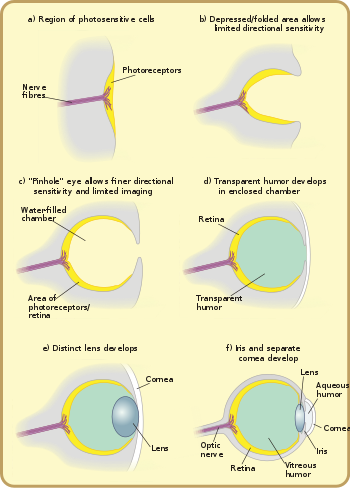
Major stages in the evolution of the eye in vertebrates.
Many researchers have institute the development of the eye bonny to study because the eye distinctively exemplifies an analogous organ found in many fauna forms. Uncomplicated light detection is found in leaner, single-celled organisms, plants and animals. Complex, image-forming eyes have evolved independently several times.[1]
Diverse eyes are known from the Burgess shale of the Middle Cambrian, and from the slightly older Emu Bay Shale.[ii] Optics vary in their visual acuity, the range of wavelengths they can detect, their sensitivity in low light, their ability to detect motion or to resolve objects, and whether they can discriminate colours.
History of research [edit]
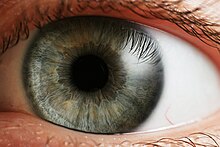
The homo eye, showing the iris
In 1802, philosopher William Paley chosen it a miracle of "pattern." In 1859, Charles Darwin himself wrote in his Origin of Species, that the evolution of the eye past natural selection seemed at kickoff glance "absurd in the highest possible caste".[iii] However, he went on that despite the difficulty in imagining information technology, its evolution was perfectly viable:
... if numerous gradations from a simple and imperfect heart to one complex and perfect can be shown to exist, each grade being useful to its possessor, every bit is certainly the case; if further, the eye ever varies and the variations be inherited, as is also certainly the case and if such variations should be useful to any animal under changing atmospheric condition of life, then the difficulty of believing that a perfect and complex centre could exist formed past natural selection, though insuperable by our imagination, should not be considered as subversive of the theory.[3]
He suggested a stepwise development from "an optic nerve only coated with pigment, and without any other machinery" to "a moderately high stage of perfection", and gave examples of existing intermediate steps.[3] Electric current enquiry is investigating the genetic mechanisms underlying heart development and evolution.[iv]
Biologist D.E. Nilsson has independently theorized about four full general stages in the evolution of a vertebrate eye from a patch of photoreceptors.[5] Nilsson and S. Pelger estimated in a classic paper that simply a few hundred thousand generations are needed to evolve a complex centre in vertebrates.[6] Another researcher, Yard.C. Young, has used the fossil tape to infer evolutionary conclusions, based on the structure of eye orbits and openings in fossilized skulls for blood vessels and nerves to get through.[7] All this adds to the growing amount of show that supports Darwin's theory.
Charge per unit of development [edit]
The first fossils of eyes found to date are from the Ediacaran period (almost 555 million years ago).[8] The lower Cambrian had a burst of apparently rapid evolution, chosen the "Cambrian explosion". One of the many hypotheses for "causes" of the Cambrian explosion is the "Lite Switch" theory of Andrew Parker: information technology holds that the development of avant-garde eyes started an arms race that accelerated evolution.[9] Before the Cambrian explosion, animals may have sensed light, merely did non utilise it for fast locomotion or navigation past vision.
The rate of eye evolution is difficult to estimate considering the fossil record, particularly of the lower Cambrian, is poor. How fast a circular patch of photoreceptor cells can evolve into a fully functional vertebrate eye has been estimated based on rates of mutation, relative advantage to the organism, and natural choice. However, the time needed for each land was consistently overestimated and the generation time was gear up to one year, which is common in modest animals. Even with these pessimistic values, the vertebrate eye would withal evolve from a patch of photoreceptor cells in less than 364,000 years.[x] [annotation 1]
Ane origin or many? [edit]
Whether the eye evolved in one case or many times depends on the definition of an eye. All eyed animals share much of the genetic machinery for eye development. This suggests that the ancestor of eyed animals had some grade of light-sensitive machinery – even if it was non a dedicated optical organ. However, fifty-fifty photoreceptor cells may have evolved more than one time from molecularly similar chemoreceptor cells. Probably, photoreceptor cells existed long before the Cambrian explosion.[11] Higher-level similarities – such equally the utilise of the protein crystallin in the independently derived cephalopod and vertebrate lenses[12] – reflect the co-option of a more than central protein to a new function within the eye.[13]
A shared trait common to all light-sensitive organs are opsins. Opsins vest to a family of photo-sensitive proteins and fall into nine groups, which already existed in the urbilaterian, the final common ancestor of all bilaterally symmetrical animals.[fourteen] Additionally, the genetic toolkit for positioning eyes is shared past all animals: The PAX6 cistron controls where optics develop in animals ranging from octopuses[15] to mice and fruit flies.[16] [17] [eighteen] Such high-level genes are, by implication, much older than many of the structures that they control today; they must originally have served a different purpose, earlier they were co-opted for eye development.[xiii]
Eyes and other sensory organs probably evolved earlier the brain: There is no demand for an information-processing organ (brain) before at that place is information to procedure.[xix] A living example are cubozoan jellyfish that possess eyes comparable to vertebrate and cephalopod camera optics despite lacking a brain.[20]
Stages of center evolution [edit]

The stigma (2) of the euglena hides a calorie-free-sensitive spot.
The primeval predecessors of the eye were photoreceptor proteins that sense light, establish even in unicellular organisms, chosen "eyespots".[21] Eyespots can sense only ambient brightness: they can distinguish light from dark, sufficient for photoperiodism and daily synchronization of cyclic rhythms. They are insufficient for vision, every bit they cannot distinguish shapes or determine the direction light is coming from. Eyespots are institute in about all major beast groups, and are common among unicellular organisms, including euglena. The euglena's eyespot, called a stigma, is located at its inductive finish. It is a pocket-size splotch of carmine pigment which shades a collection of light sensitive crystals. Together with the leading flagellum, the eyespot allows the organism to movement in response to light, often toward the light to aid in photosynthesis,[22] and to predict 24-hour interval and dark, the primary role of circadian rhythms. Visual pigments are located in the brains of more complex organisms, and are thought to have a function in synchronising spawning with lunar cycles. By detecting the subtle changes in nighttime-time illumination, organisms could synchronise the release of sperm and eggs to maximise the probability of fertilisation.[23]
Vision itself relies on a bones biochemistry which is common to all eyes. Withal, how this biochemical toolkit is used to interpret an organism's environment varies widely: eyes accept a broad range of structures and forms, all of which accept evolved quite late relative to the underlying proteins and molecules.[22]
At a cellular level, at that place announced to be two main "designs" of eyes, 1 possessed by the protostomes (molluscs, annelid worms and arthropods), the other by the deuterostomes (chordates and echinoderms).[22]
The functional unit of measurement of the eye is the photoreceptor cell, which contains the opsin proteins and responds to light past initiating a nerve impulse. The calorie-free sensitive opsins are borne on a hairy layer, to maximise the expanse. The nature of these "hairs" differs, with two basic forms underlying photoreceptor construction: microvilli and cilia.[24] In the eyes of protostomes, they are microvilli: extensions or protrusions of the cellular membrane. But in the eyes of deuterostomes, they are derived from cilia, which are separate structures.[22] However, outside the eyes an organism may use the other blazon of photoreceptor cells, for case the clamworm Platynereis dumerilii uses microvilliar cells in the eyes but has additionally deep brain ciliary photoreceptor cells.[25] The actual derivation may be more complicated, as some microvilli contain traces of cilia – only other observations announced to support a fundamental difference between protostomes and deuterostomes.[22] These considerations centre on the response of the cells to low-cal – some utilise sodium to crusade the electric signal that will form a nerve impulse, and others apply potassium; further, protostomes on the whole construct a signal past assuasive more sodium to pass through their jail cell walls, whereas deuterostomes allow less through.[22]
This suggests that when the two lineages diverged in the Precambrian, they had simply very primitive light receptors, which adult into more than complex optics independently.
Early on eyes [edit]
The basic light-processing unit of measurement of eyes is the photoreceptor cell, a specialized cell containing two types of molecules bound to each other and located in a membrane: the opsin, a light-sensitive poly peptide; and a chromophore, the pigment that absorbs lite. Groups of such cells are termed "eyespots", and take evolved independently somewhere between 40 and 65 times. These eyespots permit animals to gain just a basic sense of the direction and intensity of light, merely not enough to discriminate an object from its surroundings.[22]
Developing an optical system that can discriminate the direction of light to inside a few degrees is plain much more difficult, and only half-dozen of the thirty-some phyla[note ii] possess such a system. Notwithstanding, these phyla business relationship for 96% of living species.[22]
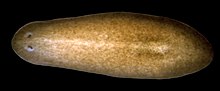
The planarian has "loving cup" eyespots that can slightly distinguish low-cal direction.
These circuitous optical systems started out as the multicellular eyepatch gradually depressed into a loving cup, which kickoff granted the ability to discriminate effulgence in directions, so in effectively and finer directions as the pit deepened. While flat eyepatches were ineffective at determining the management of low-cal, every bit a beam of light would activate exactly the same patch of photo-sensitive cells regardless of its direction, the "cup" shape of the pit eyes allowed limited directional differentiation past changing which cells the lights would hit depending upon the low-cal'southward bending. Pit optics, which had arisen by the Cambrian flow, were seen in ancient snails,[ clarification needed ] and are establish in some snails and other invertebrates living today, such equally planaria. Planaria can slightly differentiate the direction and intensity of lite considering of their cup-shaped, heavily pigmented retina cells, which shield the light-sensitive cells from exposure in all directions except for the single opening for the calorie-free. Withal, this proto-heart is still much more useful for detecting the absence or presence of light than its direction; this gradually changes every bit the eye'due south pit deepens and the number of photoreceptive cells grows, assuasive for increasingly precise visual information.[26]
When a photon is absorbed by the chromophore, a chemic reaction causes the photon'due south free energy to exist transduced into electrical energy and relayed, in higher animals, to the nervous system. These photoreceptor cells form part of the retina, a thin layer of cells that relays visual information,[27] including the calorie-free and day-length information needed by the circadian rhythm arrangement, to the brain. Even so, some jellyfish, such as Cladonema (Cladonematidae), have elaborate eyes just no encephalon. Their eyes transmit a message directly to the muscles without the intermediate processing provided by a brain.[19]
During the Cambrian explosion, the development of the middle accelerated apace, with radical improvements in image-processing and detection of light direction.[28]

After the photosensitive cell region invaginated, at that place came a signal when reducing the width of the light opening became more efficient at increasing visual resolution than continued deepening of the loving cup.[ten] By reducing the size of the opening, organisms achieved true imaging, allowing for fine directional sensing and fifty-fifty some shape-sensing. Eyes of this nature are currently found in the nautilus. Lacking a cornea or lens, they provide poor resolution and dim imaging, only are all the same, for the purpose of vision, a major improvement over the early eyepatches.[29]
Overgrowths of transparent cells prevented contamination and parasitic infestation. The chamber contents, at present segregated, could slowly specialize into a transparent humour, for optimizations such as colour filtering, higher refractive index, blocking of ultraviolet radiation, or the ability to operate in and out of h2o. The layer may, in certain classes, be related to the moulting of the organism'due south trounce or skin. An example of this tin be observed in Onychophorans where the cuticula of the shell continues to the cornea. The cornea is equanimous of either one or two cuticular layers depending on how recently the animal has moulted.[thirty] Along with the lens and two humors, the cornea is responsible for converging light and aiding the focusing of it on the back of the retina. The cornea protects the eyeball while at the same time accounting for approximately 2/3 of the eye's total refractive power.[31]
It is likely that a key reason eyes specialize in detecting a specific, narrow range of wavelengths on the electromagnetic spectrum—the visible spectrum—is that the earliest species to develop photosensitivity were aquatic, and water filters out electromagnetic radiations except for a range of wavelengths, the shorter of which we refer to equally bluish, through to longer wavelengths we identify as red. This same lite-filtering property of water also influenced the photosensitivity of plants.[32] [33] [34]
Lens formation and diversification [edit]

Light from a distant object and a near object being focused past changing the curvature of the lens
In a lensless centre, the low-cal emanating from a distant point hits the back of the eye with about the same size as the eye's aperture. With the addition of a lens this incoming lite is concentrated on a smaller surface area, without reducing the overall intensity of the stimulus.[6] The focal length of an early lobopod with lens-containing unproblematic eyes focused the image backside the retina, and so while no part of the image could exist brought into focus, the intensity of light allowed the organism to meet in deeper (and therefore darker) waters.[30] A subsequent increase of the lens'south refractive index probably resulted in an in-focus image being formed.[thirty]
The development of the lens in photographic camera-blazon eyes probably followed a dissimilar trajectory. The transparent cells over a pinhole eye's aperture split into ii layers, with liquid in between.[ citation needed ] The liquid originally served as a circulatory fluid for oxygen, nutrients, wastes, and allowed functions, allowing greater total thickness and higher mechanical protection. In addition, multiple interfaces betwixt solids and liquids increase optical power, allowing wider viewing angles and greater imaging resolution. Again, the division of layers may have originated with the shedding of skin; intracellular fluid may infill naturally depending on layer depth.[ citation needed ]
Note that this optical layout has not been establish, nor is it expected to be found. Fossilization rarely preserves soft tissues, and even if it did, the new humour would nigh certainly close equally the remains desiccated, or every bit sediment overburden forced the layers together, making the fossilized centre resemble the previous layout.
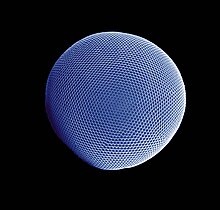
Vertebrate lenses are composed of adapted epithelial cells which have high concentrations of the poly peptide crystallin. These crystallins belong to ii major families, the α-crystallins and the βγ-crystallins. Both categories of proteins were originally used for other functions in organisms, but somewhen adapted for vision in animal eyes.[35] In the embryo, the lens is living tissue, but the cellular machinery is not transparent so must be removed earlier the organism can meet. Removing the machinery means the lens is equanimous of dead cells, packed with crystallins. These crystallins are special considering they have the unique characteristics required for transparency and role in the lens such as tight packing, resistance to crystallization, and extreme longevity, as they must survive for the entirety of the organism's life.[35] The refractive index gradient which makes the lens useful is caused by the radial shift in crystallin concentration in different parts of the lens, rather than by the specific type of poly peptide: information technology is non the presence of crystallin, merely the relative distribution of it, that renders the lens useful.[36]
Information technology is biologically difficult to maintain a transparent layer of cells.[37] Degradation of transparent, nonliving, material eased the demand for nutrient supply and waste removal. Trilobites used calcite, a mineral which today is known to be used for vision only in a single species of brittle star.[38] In other compound eyes[ verification needed ] and camera eyes, the material is crystallin. A gap between tissue layers naturally forms a biconvex shape, which is optically and mechanically ideal for substances of normal[ clarification needed ] refractive alphabetize. A arched lens confers non only optical resolution, simply aperture and low-light power, as resolution is now decoupled from hole size – which slowly increases again, free from the circulatory constraints.
Independently, a transparent layer and a nontransparent layer may separate forwards from the lens: a separate cornea and iris. (These may happen earlier or afterwards crystal degradation, or not at all.) Separation of the forwards layer again forms a humor, the aqueous humour. This increases refractive power and again eases circulatory problems. Formation of a nontransparent ring allows more than blood vessels, more circulation, and larger eye sizes. This flap around the perimeter of the lens also masks optical imperfections, which are more common at lens edges. The need to mask lens imperfections gradually increases with lens curvature and power, overall lens and center size, and the resolution and aperture needs of the organism, driven past hunting or survival requirements. This blazon is at present functionally identical to the heart of virtually vertebrates, including humans. Indeed, "the basic blueprint of all vertebrate eyes is similar."[39]
Other developments [edit]
Color vision [edit]
V classes of visual opsins are found in vertebrates. All but i of these developed prior to the divergence of Cyclostomata and fish.[40] The 5 opsin classes are variously adapted depending on the light spectrum encountered. Every bit light travels through h2o, longer wavelengths, such as reds and yellows, are absorbed more quickly than the shorter wavelengths of the greens and dejection. This creates a slope in the spectral power density, with the average wavelength condign shorter as water depth increases.[41] The visual opsins in fish are more sensitive to the range of light in their habitat and depth. Nevertheless, state environments do not vary in wavelength composition, so that the opsin sensitivities amongst land vertebrates does not vary much. This directly contributes to the significant presence of communication colors.[40] Colour vision gives distinct selective advantages, such as better recognition of predators, food, and mates. Indeed, it is possible that unproblematic sensory-neural mechanisms may selectively control general behavior patterns, such as escape, foraging, and hiding. Many examples of wavelength-specific behaviors have been identified, in two main groups: Below 450 nm, associated with directly light, and to a higher place 450 nm, associated with reflected light.[42] As opsin molecules were tuned to detect different wavelengths of light, at some signal color vision developed when the photoreceptor cells used differently tuned opsins.[27] This may have happened at any of the early stages of the heart's development, and may have disappeared and reevolved as relative selective pressures on the lineage varied.
Polarization vision [edit]
Polarization is the organisation of disordered light into linear arrangements, which occurs when lite passes through slit similar filters, also every bit when passing into a new medium. Sensitivity to polarized low-cal is particularly useful for organisms whose habitats are located more than a few meters under water. In this environment, colour vision is less undecayed, and therefore a weaker selective cistron. While most photoreceptors have the ability to distinguish partially polarized light, terrestrial vertebrates' membranes are orientated perpendicularly, such that they are insensitive to polarized calorie-free.[43] However, some fish can discern polarized lite, demonstrating that they possess some linear photoreceptors. Additionally, cuttlefish are capable of perceiving the polarization of light with high visual fidelity, although they appear to lack any pregnant chapters for color differentiation.[44] Like colour vision, sensitivity to polarization can assist in an organism'due south power to differentiate surrounding objects and individuals. Because of the marginal reflective interference of polarized light, it is often used for orientation and navigation, as well as distinguishing concealed objects, such equally disguised prey.[43]
Focusing mechanism [edit]
By utilizing the iris sphincter muscle, some species motility the lens back and along, some stretch the lens flatter. Some other mechanism regulates focusing chemically and independently of these two, by controlling growth of the eye and maintaining focal length. In addition, the educatee shape tin be used to predict the focal arrangement being utilized. A slit pupil tin can indicate the common multifocal system, while a round pupil usually specifies a monofocal system. When using a round form, the pupil will tuck nether vivid lite, increasing the focal length, and volition dilate when nighttime in lodge to subtract the depth of focus.[45] Note that a focusing method is non a requirement. Every bit photographers know, focal errors increase as aperture increases. Thus, endless organisms with small-scale eyes are agile in direct sunlight and survive with no focus mechanism at all. Every bit a species grows larger, or transitions to dimmer environments, a means of focusing demand only appear gradually.
Placement [edit]
Predators generally have optics on the front of their heads for better depth perception to focus on casualty. Prey animals' optics tend to be on the side of the caput giving a wide field of view to detect predators from any direction.[46] [47] Flatfish are predators which lie on their side on the bottom, and have eyes placed asymmetrically on the same side of the head. A transitional fossil from the common symmetric position to the disproportionate position is Amphistium.
Footnotes [edit]
- ^ David Berlinski, an intelligent design proponent, questioned the basis of the calculations, and the author of the original paper refuted Berlinski'southward criticism.
- Berlinski, David (April 2001). "Commentary mag".
- Nilsson, Dan-Eastward. "Beware of Pseudo-science: a response to David Berlinski'south attack on my calculation of how long it takes for an eye to evolve".
- "Development of the Eye" on PBS
- ^ The precise number varies from author to author.
See as well [edit]
- Ocelloid
- Sensory organs of gastropods § Optics
References [edit]
- ^ ""An important cue for understanding eye evolution is the distinction between unlike types of photoreceptor cells. Salvini-Plawen and Mayr ( 1977 ) noted a remarkable diverseness of photoreceptor cell morphology across the animal kingdom, and suggested that photoreceptors evolved independently numerous times." – Land, M.F. and Nilsson, D.-E., Beast Eyes(ii-nd ed.), Oxford University Press, Oxford (2012), p. 7.
- ^ Lee, Chiliad. S. Y.; Jago, J. B.; Garcia-Bellido, D. C.; Edgecombe, Thou. East.; Gehling, J. G; Paterson, J. R. (2011). "Modern eyes in exceptionally preserved eyes of Early on Cambrian arthropods from Australia". Nature. 474 (7353): 631–634. Bibcode:2011Natur.474..631L. doi:10.1038/nature10097. PMID 21720369. S2CID 4417647.
- ^ a b c Darwin, Charles (1859). On the Origin of Species. London, Britain: John Murray.
- ^ Gehring, Due west.J. (2005). "New perspectives on middle development and the evolution of eyes and photoreceptors". J. Hered. 96 (3): 171–84. doi:10.1093/jhered/esi027. PMID 15653558.
- ^ Nilsson, D.-E. (2013). "Center evolution and its functional ground". Visual Neuroscience. 30 (1–two): 5–20. doi:ten.1017/s0952523813000035. PMC3632888. PMID 23578808.
- ^ a b Nilsson, D.-Due east.; Pelger, S. (1994). "A pessimistic guess of the time required for an eye to evolve". Proceedings of the Royal Society B: Biological Sciences. 256 (1345): 53–58. Bibcode:1994RSPSB.256...53N. doi:10.1098/rspb.1994.0048. PMID 8008757. S2CID 13061351.
- ^ Young, G.C. (2008). "Early on evolution of the vertebrate center – fossil evidence". Evo Edu Outreach. ane (4): 427–438. doi:10.1007/s12052-008-0087-y.
- ^ McMenamin, Mark A. Due south. (2016). Dynamic Paleontology: Using Quantification and Other Tools to Decipher the History of Life. Springer. ISBN978-3-319-22776-four.
- ^ Parker, Andrew (2003). In the Blink of an Eye: How Vision Sparked the Large Bang of Development . Cambridge, MA: Perseus Pub. ISBN978-0-7382-0607-3.
- ^ a b Nilsson, D-E; Pelger Southward (1994). "A pessimistic estimate of the fourth dimension required for an eye to evolve". Proceedings of the Regal Guild B. 256 (1345): 53–58. Bibcode:1994RSPSB.256...53N. doi:10.1098/rspb.1994.0048. PMID 8008757. S2CID 13061351.
- ^ Nilsson, D. E. (1996). "Eye ancestry: old genes for new optics". Current Biology. half-dozen (ane): 39–42. doi:10.1016/S0960-9822(02)00417-seven. PMID 8805210.
- ^ Zinovieva, R.; Piatigorsky, J.; Tomarev, S. I. (1999). "O-Crystallin, arginine kinase and ferritin from the octopus lens". Biochimica et Biophysica Acta (BBA) - Poly peptide Structure and Molecular Enzymology. 1431 (2): 512–517. doi:x.1016/S0167-4838(99)00066-7. PMID 10350626.
- ^ a b Scotland, R. W. (2010). "Deep homology: A view from systematics". BioEssays. 32 (5): 438–449. doi:10.1002/bies.200900175. PMID 20394064. S2CID 205469918.
- ^ Ramirez, Md; Pairett, AN; Pankey, MS; Serb, JM; Speiser, DI; Swafford, AJ; Oakley, Thursday (26 Oct 2016). "The last mutual ancestor of most bilaterian animals possessed at least 9 opsins". Genome Biology and Evolution. 8 (12): 3640–3652. doi:10.1093/gbe/evw248. PMC5521729. PMID 28172965.
- ^ Yoshida, Masa-aki; Yura, Kei; Ogura, Atsushi (5 March 2014). "Cephalopod eye development was modulated past the acquisition of Pax-6 splicing variants". Scientific Reports. 4: 4256. Bibcode:2014NatSR...4E4256Y. doi:10.1038/srep04256. PMC3942700. PMID 24594543.
- ^ Halder, G.; Callaerts, P.; Gehring, W. J. (1995). "New perspectives on eye development". Electric current Opinion in Genetics & Evolution. 5 (v): 602–609. doi:10.1016/0959-437X(95)80029-8. PMID 8664548.
- ^ Halder, G.; Callaerts, P.; Gehring, W. (1995). "Induction of ectopic eyes past targeted expression of the eyeless cistron in Drosophila". Science. 267 (5205): 1788–92. Bibcode:1995Sci...267.1788H. doi:ten.1126/scientific discipline.7892602. PMID 7892602.
- ^ Tomarev, South. I.; Callaerts, P.; Kos, Fifty.; Zinovieva, R.; Halder, G.; Gehring, W.; Piatigorsky, J. (1997). "Squid Pax-6 and eye development". Proceedings of the National Academy of Sciences of the U.s.a. of America. 94 (6): 2421–2426. Bibcode:1997PNAS...94.2421T. doi:10.1073/pnas.94.6.2421. PMC20103. PMID 9122210.
- ^ a b Gehring, Due west. J. (13 January 2005). "New Perspectives on Eye Development and the Development of Optics and Photoreceptors". Journal of Heredity. 96 (3): 171–184. doi:x.1093/jhered/esi027. PMID 15653558.
- ^ Coates, Melissa M. (2003). "Visual Ecology and Functional Morphology of Cubozoa (Cnidaria)". Integrative and Comparative Biology. 43 (4): 542–548. doi:10.1093/icb/43.4.542. ISSN 1540-7063. PMID 21680462.
- ^ Schwab, I R (February 2018). "The evolution of eyes: major steps. The Keeler lecture 2017: centenary of Keeler Ltd". Middle. 32 (2): 302–313. doi:10.1038/eye.2017.226. ISSN 0950-222X. PMC5811732. PMID 29052606.
- ^ a b c d e f yard h M F Land; R D Fernald (1992). "The Evolution of Eyes". Annual Review of Neuroscience. fifteen: 1–29. doi:10.1146/annurev.ne.15.030192.000245. PMID 1575438.
- ^ Caballes, Ciemon Frank; Pratchett, Morgan South. (29 March 2017). "Environmental and biological cues for spawning in the crown-of-thorns starfish". PLOS Ane. 12 (3): e0173964. Bibcode:2017PLoSO..1273964C. doi:x.1371/periodical.pone.0173964. ISSN 1932-6203. PMC5371309. PMID 28355236.
- ^ Autrum, H (1979). "Introduction". In H. Autrum (ed.). Comparative Physiology and Evolution of Vision in Invertebrates- A: Invertebrate Photoreceptors. Handbook of Sensory Physiology. Vol. Vii/6A. New York: Springer-Verlag. pp. 6–9. ISBN978-iii-540-08837-0.
- ^ Arendt, D.; Tessmar-Raible, K.; Snyman, H.; Dorresteijn, A.Westward.; Wittbrodt, J. (29 October 2004). "Ciliary Photoreceptors with a Vertebrate-Type Opsin in an Invertebrate Brain". Science. 306 (5697): 869–871. Bibcode:2004Sci...306..869A. doi:10.1126/science.1099955. PMID 15514158. S2CID 2583520.
- ^ Centre-Evolution? Archived 15 September 2012 at the Wayback Machine
- ^ a b Fernald, Russell D. (2001). The Evolution of Eyes: How Do Optics Capture Photons? Archived 19 March 2006 at the Wayback Machine Karger Gazette 64: "The Eye in Focus".
- ^ Conway-Morris, Southward. (1998). The Crucible of Creation. Oxford: Oxford University Press.
- ^ Dawkins, Richard (1986). The Blind Watchmaker.
- ^ a b c Schoenemann, B.; Liu, J. North.; Shu, D. G.; Han, J.; Zhang, Z. F. (2008). "A miniscule optimized visual system in the Lower Cambrian". Lethaia. 42 (iii): 265–273. doi:10.1111/j.1502-3931.2008.00138.x.
- ^ Ali, Chiliad.A. and M. A. Klyne. 1985. Vision in vertebrates. New York: Plenum Press
- ^ Fernald, Russell D. (2001). The Development of Eyes: Why Practise We See What We See? Archived 19 March 2006 at the Wayback Auto Karger Gazette 64: "The Middle in Focus".
- ^ Fernald, Russell D. (1998). Aquatic Adaptations in Fish Eyes. New York, Springer.
- ^ Fernald RD (1997). "The development of optics". Brain Behav. Evol. 50 (4): 253–9. doi:10.1159/000113339. PMID 9310200.
- ^ a b Slingsby, C.; Wistow, M. J.; Clark, A. R. (2013). "Evolution of crystallins for a role in the vertebrate eye lens". Protein Science. 22 (iv): 367–380. doi:ten.1002/pro.2229. PMC3610043. PMID 23389822.
- ^ Fernald, Russell D. (2001). The Development of Eyes: Where Do Lenses Come From? Karger Gazette 64: "The Eye in Focus".
- ^ Inyushin, Mikhail; Meshalkina, Daria; Zueva, Lidia; Zayas-Santiago, Astrid (28 June 2019). "Tissue Transparency In Vivo". Molecules. 24 (thirteen): 2388. doi:10.3390/molecules24132388. ISSN 1420-3049. PMC6651221. PMID 31261621.
- ^ Burgess, Daniel Due south. (2001). Breakable Star Features Calcite Lenses, Photonics Spectra
- ^ Ali, Mohamed Ather; Klyne, 1000. A. (1985). Vision in Vertebrates. New York: Plenum Printing. p. one. ISBN978-0-306-42065-8.
- ^ a b Osorio, D; Vorobyev, M (2005). "Photo-receptor spectral sensitivities in terrestrial animals: adaptations for luminescence and colour vision". Proc. R. Soc. B. 272 (1574): 1745–52. doi:ten.1098/rspb.2005.3156. PMC1559864. PMID 16096084.
- ^ Gühmann, Martin; Jia, Huiyong; Randel, Nadine; Verasztó, Csaba; Bezares-Calderón, Luis A.; Michiels, Nico K.; Yokoyama, Shozo; Jékely, Gáspár (Baronial 2015). "Spectral Tuning of Phototaxis by a Go-Opsin in the Rhabdomeric Eyes of Platynereis". Current Biology. 25 (17): 2265–2271. doi:10.1016/j.cub.2015.07.017. PMID 26255845.
- ^ Menzel, Randolf (1979). "Spectral Sensitivity and Color Vision in Invertebrates". In H. Autrum (ed.). Comparative Physiology and Evolution of Vision in Invertebrates- A: Invertebrate Photograph-receptors. Handbook of Sensory Physiology. Vol. VII/6A. New York: Springer-Verlag. pp. 504–506, 551–558. ISBN978-3-540-08837-0.
- ^ a b Cronin, T; Shashar, N; Caldwell, R; Marshall, J; Cheroske, A; Chiou, T (2003). "Polarization vision and its role in biological signaling". Integr. Comp. Biol. 43 (four): 549–58. doi:10.1093/icb/43.4.549. PMID 21680463.
- ^ Mäthger, Lydia M.; Barbosa, Alexandra; Miner, Simon; Hanlon, Roger T. (1 May 2006). "Color incomprehension and contrast perception in cuttlefish (Sepia officinalis) determined by a visual sensorimotor analysis". Vision Inquiry. 46 (11): 1746–1753. doi:x.1016/j.visres.2005.09.035. PMID 16376404. S2CID 16247757.
- ^ Malstrom, T; Kroger, R (2006). "pupil shape and lens optics in the optics of terrestrial vertebrates". The Periodical of Experimental Biology.
- ^ "Carnivores". U.S. Department of the Interior, Bureau of Land Direction. 14 December 2009. Archived from the original on fourteen June 2011. Retrieved 28 March 2011.
- ^ Boroditsky, Lera (24 June 1999). "Light & Optics: Lecture Notes". Lecture Notes. Stanford. Archived from the original on five July 2010. Retrieved eleven May 2010.
Further reading [edit]
- Lamb TD, Collin SP, Pugh EN (December 2007). "Evolution of the vertebrate eye: opsins, photoreceptors, retina and eye cup". Nat. Rev. Neurosci. 8 (12): 960–76. doi:10.1038/nrn2283. PMC3143066. PMID 18026166. Illustration. Review
- Lamb, TD (2011). "Development of the Eye" (PDF). Scientific American. 305 (1): 64–69. Bibcode:2011SciAm.305f..64L. doi:10.1038/scientificamerican0711-64. Archived from the original (PDF) on 12 Dec 2013. Retrieved 28 April 2013.
- Land, Michael F.; Nilsson, Dan-Eric (2012). "The origin of vision". Animal Eyes (2 ed.). Oxford: Oxford University Press. pp. one–22. ISBN978-0199581146.
- Journal Evolution: Education and Outreach [ dead link ] Volume one, Number 4 / Oct 2008. Special Issue: The Evolution of Eyes. 26 articles, free access.
- Ivan R. Schwab (2012). Evolution'due south Witness: How Eyes Evolved. New York: Oxford University Printing. ISBN9780195369748.
- Hayakawa S, Takaku Y, Hwang JS, Horiguchi T, Suga H, Gehring W, et al. (2015). "Role and evolutionary origin of unicellular camera-type eye structure". PLOS One. x (three): e0118415. Bibcode:2015PLoSO..1018415H. doi:x.1371/journal.pone.0118415. PMC4348419. PMID 25734540.
- Greuet, C (1968). "System ultrastructurale de l'ocelle de deux Peridiniens Warnowiidae, Erythropsis pavillardi Kofoid et Swezy et Warnowia pulchra Schiller". Protistologica. 4: 209–230.
- Gregory Southward. Gavelis, Shiho Hayakawa, Richard A. White Iii, Takashi Gojobori, Curtis A. Suttle, Patrick J. Keeling, Brian S. Leander (2015). "Centre-like ocelloids are built from different endosymbiotically acquired components". Nature. 523 (7559): 204–seven. Bibcode:2015Natur.523..204G. doi:10.1038/nature14593. hdl:10754/566109. PMID 26131935. S2CID 4462376.
{{cite journal}}: CS1 maint: uses authors parameter (link) - Oakley, Todd H.; Speiser, Daniel I. (2015). "How Complexity Originates: The Evolution of Animal Optics". Annual Review of Ecology, Evolution, and Systematics. 46: 237–260. doi:10.1146/annurev-ecolsys-110512-135907.
- Ed Young; photographs past David Liittschwager (February 2016). "Inside the Eye: Nature'due south Well-nigh Exquisite Cosmos". National Geographic. 229 (2): 30–57.
External links [edit]
- "Evolution of the Eye". WGBH Educational Foundation and Clear Blue Sky Productions. PBS. 2001.
- Creationism Disproved? Video from the National Center for Science Education on the evolution of the eye
- Evolution: Education and Outreach Special Issue: Development and Eyes book i, number 4, October 2008, pages 351–559. ISSN 1936-6426 (Print) 1936–6434 (Online)
Source: https://en.wikipedia.org/wiki/Evolution_of_the_eye
Posted by: palacioscaved1966.blogspot.com
0 Response to "What Does The Wide Variety Of Different Types Of Animal Eyes Represent"
Post a Comment