

How Do Limiting Factors Impact An Animal's Niche
| Duikers Temporal range: Belatedly Miocene to present | |
|---|---|
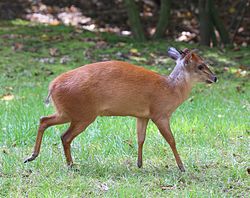 | |
| Red forest duiker, Cephalophus natalensis | |
Scientific classification  | |
| Kingdom: | Animalia |
| Phylum: | Chordata |
| Grade: | Mammalia |
| Club: | Artiodactyla |
| Family: | Bovidae |
| Subfamily: | Cephalophinae Blyth, 1863 |
| Genera | |
| Cephalophus | |
A duiker is a minor to medium-sized brownish antelope native to sub-Saharan Africa, plant in heavily wooded areas. The 22 extant species, including three sometimes considered to be subspecies of the other species, form the subfamily Cephalophinae or the tribe Cephalophini.
Taxonomy and phylogeny [edit]
| Cladogram of the subfamily Cephalophinae (duikers) and human relationship with Tragelaphus, based on Johnston et al. 2012 |
The tribe Cephalophini[1] (formerly the subfamily Cephalophinae) comprises three genera and 22 species, iii of which are sometimes considered to be subspecies of the other species. The 3 genera include Cephalophus (15 species and three disputed taxa), Philantomba (iii species), and Sylvicapra (one species). The subfamily was commencement described by British zoologist John Edward Greyness in 1871 in Proceedings of the Zoological Society of London. The scientific proper noun "Cephalophinae" probably comes from the combination of the New Latin give-and-take cephal, meaning caput, and the Greek word lophos, meaning crest.[2]
The iii disputed species in Cephalophus are Brooke's duiker (C. brookei), Ruwenzori duiker (C. rubidis), and the white-legged duiker (C. crusalbum). Considered to be a subspecies of Ogilby's duiker (C. nigrifrons), Brooke's duiker was elevated to species status past British ecologist Peter Grubb in 1998. Its status equally a species was further seconded in a 2002 publication by Grubb and colleague Colin Groves.[3] However, zoologists such as Jonathan Kingdon keep to care for it equally a subspecies.[4] The Ruwenzori duiker is generally considered to exist a subspecies of the black-fronted duiker (C. nigrifrons). Nonetheless, significant differences from another race of the same species, C. northward. kivuensis, with which it is sympatric on the Ruwenzori mount range, led Kingdon to suggest that it might exist a unlike species altogether.[5] Grubb treated the white-legged duiker as a subspecies of Ogilby's duiker in 1978,[6] merely regarded as an independent species by him and Groves afterwards a revision in 2011.[vii] This was supported by a 2003 study.[8]
A 2001 phylogenetic study divided Cephalophus into three distinct lineages - the giant duikers, east African red duikers, and west African blood-red duikers. Abbott's duiker (C. spadix), the bay duiker (C. dorsalis), Jentink's duiker (C. jentinki) and the yellow-backed duiker (C. silvicultor) were classified every bit the giant duikers. The east African cherry duikers include the black-fronted duiker (C. nigrifrons), Harvey's duiker (C. harveyi), red-flanked duiker (C. rufilatus), carmine wood duiker (C. natalensis), Ruwenzori duiker, and white-bellied duiker (C. leucogaster). The tertiary group, the west African red duikers, comprises the black duiker (C. niger), Ogilby's duiker, Peters'south duiker (C. callipygus), and Weyns'due south duiker (C. weynsi). However, the status of two species, Aders'due south duiker and zebra duiker, remained dubious.[9]
In 2012, Anne R. Johnston (of the University of Orleans) and colleagues constructed a cladogram of the subfamily Cephalophinae (duiker) based on mitochondrial assay.[10] [11]
Etymology [edit]
The mutual name "duiker" comes from the Afrikaans word duik, or Dutch duiken - both mean "to dive",[12] which refers to the exercise of the animals to frequently dive into vegetation for cover.[13]
Description [edit]

Duikers are split into two groups based on their habitat – wood and bush duikers. All forest species inhabit the rainforests of sub-Saharan Africa, while the but known bush duiker, grey common duiker occupies savannas. Duikers are very shy, elusive creatures with a fondness for dense cover; those that tend to live in more than open areas, for example, are quick to disappear into thickets for protection.
Because of their rarity and interspersed population, not much is known nigh duikers; thus, further generalizations are widely based on the most ordinarily studied cherry-red woods, bluish, xanthous-backed, and common gray duiker. In tropical rainforest zones of Africa, people nonselectively hunt duikers for their hibernate, meat, and horns at highly unsustainable rates.[14] Population trends for all species of duikers, excluding the common duiker and the smallest blueish duiker, are significantly decreasing; Aders' and specially the larger duiker species such as the Jentink's and Abbott'due south duikers, are at present considered endangered by the IUCN Red List of Threatened Species.[xv]
Beefcake and physiology [edit]
Duikers range from the three-kilogram (six+ 1⁄ii -pound) bluish duiker to the 70 kg (150 lb) yellow-backed duiker.[14] With their bodies low to the ground and with very brusque horns, forest duikers are built to navigate effectively through dense rainforests and quickly dive into bushes when threatened.[16] Since the common grey duiker lives in more open up areas, such as savannas, it has longer legs and vertical horns, which allow it to run faster and for longer distances; but the males, which are more confrontational and territorial, showroom horns. As well, duikers take well-developed preorbital glands, which resemble slits under their eyes, or in the cases of blue duikers, pedal glands on their hooves.[16] Males use secretions from these glands to mark their territories.
Besides reproduction, duikers behave in highly independent manner and prefer to human activity lonely. This may, in part, explain the limited sexual size dimorphism shown by virtually duiker species, excluding the common duiker, in which the females are distinctly larger than the males.[17]
Besides, body size is proportional to the amount of food intake and the size of food. Anatomical features such equally "the head and neck shape" also limit the corporeality and size of food intake. "Anatomical variations... impose further constraints on ingestion" causing differences in the nutrient sources among different species of duiker.[fourteen]
Behaviour [edit]
Interactions [edit]
In 2001, Helen Newing'due south study in Westward Africa on the interactions of duikers plant that body size, "habitat preference, and activity patterns" were the main differentiating factors among the 7 species of duikers. These differences specific to each species of duiker allow them to coexist by "limiting niche overlap".[14] All the same, although some species are nevertheless to be considered 'endangered', because of the repeated impairment and Habitat fragmentation of their habitat by human activities, such specialization of the niches are gradually becoming dumb and are contributing to the significant decrease in population.
Due to their relative size and reserved nature, duikers' primary defense mechanism is to hide from predators. Duikers are known for their extreme shyness, freezing at the slightest sign of a threat and diving into the nearest bush.[sixteen] Duikers' "social beliefs" involves maintaining "[sufficient altitude] between" any other private.[sixteen] However, in contrast to their conserved nature, duikers are more ambitious when dealing with territories; they mark their territory and their mates with secretions from their preorbital glands and fight other duikers that challenge their government.[18] Male mutual duikers, especially the younger males, marker their territories as well by defecation.[17]
For those duikers that travel alone, they choose to collaborate with other duikers in one case or twice a twelvemonth, solely for the purpose of mating.[xiv] Although duikers occasionally form temporary groups to "gather…fallen fruit", considering so fiddling is known well-nigh how they interact and affect one another, determining which factors contribute the most to their endangerment is difficult.[16]
Duikers prefer to alive alone or as pairs to avert the contest that comes from living in a large group. They have also evolved to become highly selective feeders, feeding simply on specific parts of plants. In fact, in his study regarding the relationship between "group size and feeding manner", P.J. Jarman found that the more selective an organism's diet is, the more dispersed its nutrient will be, and consequently, the smaller the grouping becomes.[16]
Diet [edit]
Duikers are primarily browsers rather than grazers, eating leaves, shoots, seeds, fruit, buds, and bawl, and often following flocks of birds or troops of monkeys to take reward of the fruit they driblet. They supplement their diets with meat: duikers consume insects and feces from time to time and even manage to capture rodents or small birds. Since food is the deciding factor, diverse locations of food sources frequently dictate the distribution of duikers. While they feed on a wide range of plants, they choose to swallow specific parts of the establish that are most nutritious. Therefore, to feed efficiently, they must exist familiar with their territory and be thoroughly acquainted with the geography and distribution of specific plants.[xvi] For such reasons, duikers readjusting to novel environments created by human settlements and deforestation is not easy.
The smaller species, for case the blue duiker, generally tend to swallow various seeds, while larger ones tend to feast more than on larger fruits.[14] Since blue duikers are very minor, they are "more than efficient [in] digesting small-scale, high-quality items". Receiving virtually of their water from the foods they eat, duikers practise not rely on drinking water and tin "be plant in waterless localities".[18] [19]
Activity patterns [edit]
Duikers can exist diurnal, nocturnal, or both. Since the bulk of the food source is available in the daytime, duiker evolution has rendered well-nigh duikers as diurnal. A correlation exists between torso size and sleep blueprint in duikers. While smaller to medium-sized duikers bear witness increased activeness and scavenge for nutrient during the daytime, larger duikers are most agile at nighttime.[14] An exception to this is the yellowish-backed duiker, the largest species, which is agile during both day and nighttime.[14]
Distribution and abundance [edit]
Duikers are found sympatrically in many different regions. Most species dwell in the tropical rainforests of Cardinal and West Africa, creating overlapping regions among different species of wood duikers. Although "body size is the primary factor in defining the central niches of each species", often dictating the distribution and abundance of duikers in a given habitat,[xiv] distinguishing between the numerous species of duikers based purely on distribution and abundance is often hard.[14] For case, the blue duiker and red forest duiker coexist inside a small area of Mossapoula, Central African Republic. While blue duikers are seen more frequently than ruddy forest duikers "in the heavily hunted area of Mossapoula, Fundamental African Republic",[20] blood-red forest duikers are more than observed in a less exploited regions such as the western Dja Reserve, Republic of cameroon.[21]
Ecology [edit]
Conservation of duikers has a direct and critical human relationship with their ecology. Disruption of balance in the system leads to unprecedented competition, both interspecific and intraspecific.[fourteen] Earlier intervention, the organization of specialized resource in which larger duikers exploit a particular blazon of nutrient and smaller duikers on another, is functional as modeled in the diurnal and nocturnal nature of the duikers; this allows the niche to be shared by others without distinct interspecific competition. Similarly, they decrease intraspecific competition by beingness solitary, independent, and selective in eating habits. In effect, disruption of the competitive balance in one habitat often cascades its effect on to the competitive balance in another habitat.[14]
Likewise, a correlation exists between body size and diet. Larger animals have more robust digestive systems, stronger jaws, and wider necks, which allow them to swallow lower-quality foods and larger fruits and seeds.[xiv]
Similarly, bay and Peters'south duikers tin can coexist considering of their different slumber patterns. This allows Peters'south duikers to swallow fruits past day, and the bay duikers to swallow what is left past dark. In consequence of such a life pattern, the Bay duiker'due south digestive system has evolved to consume remaining, rather poor-quality foods.[xiv]
Another disquisitional influence that duikers have on the environment is acting as "seed dispersers for some plants".[22] [23] They maintain a mutualistic relationship with certain plants; the plants serve equally a nutritious and abundant nutrient source for the duikers, and simultaneously benefit from the extensive dispersal of their seeds past the duikers.
Conservation [edit]

Duikers live in an environment where fifty-fifty a subtle alter in their life patterns can profoundly impact the surrounding ecosystem. Two of the main factors that directly atomic number 82 to duiker extinction are "habitat loss" and overexploitation. Constant urbanization and the process of "shifting agriculture" is gradually taking over many of duikers' habitats; at the same time, overexploitation is also permitting the overgrowth of other interacting species, resulting in an inevitable disruption of coexistence.[24]
Overexploitation of duikers affects their population and organisms that rely on them for survival. For instance, plants that depend on duikers for seed dispersal may lose their primary method of reproduction, and other organisms that depend on these particular plants equally their resources would too have their major source of nutrient reduced.
Duikers are often captured for bushmeat. In fact, duikers are one of the most hunted animals "both in terms of number and biomass" in Central Africa.[25] For example, in areas near the African rain forests, because people practise not raise their own livestock, "bushmeat is what most people of all classes rely on as their source of protein"[26] For these people, if the trend of overexploitation continues at such a high rate, the furnishings of the population decrease in duikers will exist too astringent for these organisms to serve as a reliable nutrient source.
In addition to the unnaturally high demand for bushmeat, unenforced hunting law is a perpetual threat to many species, including the duiker. Most hunters believe that the diminishing number of animals was due to overexploitation. "The direct effects of hunting consist of two main aspects: overexploitation of target species and incidental hunting of nontargeted or rare species because hunting is largely nonselective".[fourteen]
To avoid this outcome, viable methods of conserving duikers are access restriction and captive breeding. Access restriction involves imposing "temporal or spatial restrictions" on hunting duikers.[14] Temporal restrictions include endmost off certain seasons, such as the main birth season, to hunting; spatial restrictions include endmost off certain regions where endangered duikers are found.[xiv] Captive breeding has been used and is oft looked to as a solution to ensuring the survival of the duiker population; however, due to the duikers' low reproductive rate, even with the protection provided by the conservationists, convict breeding would non increase the overall population's growth rate.[14]
The greatest challenge facing the conservation of duikers is the lack of sufficient noesis regarding these organisms, coupled with their unique population dynamics.[14] The need is to not only thoroughly understand their population dynamics, but also institute methods to differentiate among the diverse species.
Bushmeat industry [edit]
The World Wellness System (WHO) has identified the sale of duiker bushmeat as contributing to the spread of Filoviruses such equally Ebola, citing Georges et al., 1999. The WHO notes that risk of infection predominantly arises from slaughter and preparation of meat, and that consumption of properly cooked meat does not pose a risk.[27]
Species [edit]
- Tribe Cephalophini
-
- Genus Cephalophus
-
- Abbott's duiker, C. spadix
- Aders'southward duiker, C. adersi
- Bay duiker, C. dorsalis
- Black duiker, C. niger
- Black-fronted duiker, C. nigrifrons
- Brooke'southward duiker, C. brookei
- Harvey'southward duiker, C. harveyi
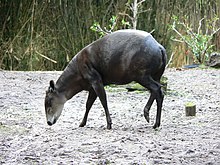
- Jentink's duiker, C. jentinki
- Ogilby'south duiker, C. ogilbyi
- Peters's duiker, C. callipygus
- Crimson-flanked duiker, C. rufilatus
- Red forest duiker, C. natalensis
- Ruwenzori duiker, C. rubidus (may be a subspecies of the blackness-fronted duiker or the red-flanked duiker)
- Weyns's duiker, C. weynsi
- White-bellied duiker, C. leucogaster
- White-legged duiker C. crusalbum (may be a subspecies of Ogilby's duiker)
- Yellow-backed duiker, C. silvicultor
- Zebra duiker, C. zebra
- Genus Philantomba
-
- Bluish duiker, P. monticola
- Maxwell's duiker, P. maxwellii
- Walter'southward duiker, P. walteri
- Genus Sylvicapra
-
- Common duiker, South. grimmia
Run across as well [edit]
- List of even-toed ungulates past population
Notes [edit]
- ^ Database, Mammal Diverseness (2021-11-06), Mammal Diversity Database, Zenodo, retrieved 2022-01-30
- ^ "Cephalophus". Merriam-Webster Dictionary . Retrieved xi Feb 2016.
- ^ Wilson, D.E.; Reeder, D.M., eds. (2005). Mammal Species of the Globe: A Taxonomic and Geographic Reference (3rd ed.). Johns Hopkins Academy Press. p. 712. ISBN978-0-8018-8221-0. OCLC 62265494.
- ^ IUCN SSC Antelope Specialist Group (2016). "Cephalophus ogilbyi ssp. brookei". IUCN Red List of Threatened Species. 2016: east.T136902A50198130. doi:10.2305/IUCN.UK.2016-1.RLTS.T136902A50198130.en . Retrieved 13 November 2021.
- ^ J., Kingdon (2015). The Kingdon Field Guide to African Mammals (2nd ed.). Princeton, New Jersey (USA): Princeton University Printing. p. 537. ISBN9780691164533.
- ^ Grubb, P. (1978). "A new antelope from Gabon". Zoological Periodical of the Linnean Guild. 62 (4): 373–lxxx. doi:10.1111/j.1096-3642.1978.tb01048.x.
- ^ Groves, C.; Grubb, P. (2011). Ungulate Taxonomy. Baltimore, Maryland: Johns Hopkins University Press. p. 272. ISBN9781421400938.
- ^ Cotterill, F.P.D. (2003). Plowman, A. (ed.). Ecology and conservation of small antelope: Proceedings of an international symposium on duiker and dwarf antelope in Africa. Filander-Verlag. pp. 59–118. ISBN9783930831524.
- ^ van Vuuren, B.J.; Robinson, T.J. (2001). "Retrieval of 4 adaptive lineages in duiker antelope: evidence from mitochondrial Deoxyribonucleic acid sequences and fluorescence in situ hybridization". Molecular Phylogenetics and Evolution. 20 (three): 409–25. doi:10.1006/mpev.2001.0962. PMID 11527467.
- ^ Johnston, A.R; Anthony, Northward.M (2012). "A multi-locus species phylogeny of African woods duikers in the subfamily Cephalophinae: bear witness for a recent radiations in the Pleistocene". BMC Evol. Biol. 12: 120. doi:10.1186/1471-2148-12-120. PMC3523051. PMID 22823504.
- ^ Johnston, A.R.; Morikawa, K. K.; Ntie, S.; Anthony, N. M. (2011). "Evaluating DNA barcoding criteria using African duiker antelope (Cephalophinae) as a test instance". Conservation Genetics. 12 (5): 1173–82. doi:10.1007/s10592-011-0220-2. ISSN 1572-9737. S2CID 22520513.
- ^ "Duiker". Merriam-Webster Dictionary . Retrieved 17 February 2016.
- ^ Skinner, J.D.; Chimimba, C.T. (2005). The Mammals of the Southern African Subregion (3rd ed.). Cambridge: Cambridge University Press. p. 669. ISBN9780521844185.
- ^ a b c d e f k h i j m l thou n o p q r s Newing 2001.
- ^ IUCN Scarlet Listing.
- ^ a b c d due east f k Jarman 1974.
- ^ a b Lunt 2011.
- ^ a b Keymer 1969.
- ^ Lydekker 1926.
- ^ Noss 2000.
- ^ Muchaal 1999.
- ^ Redford 1992.
- ^ Wilkie 1998.
- ^ Weber 2001
- ^ Muchall 1999.
- ^ Anadu 1988.
- ^ WHO experts consultation on Ebola Reston pathogenicity in humans. Geneva, Switzerland, ane April 2009
References [edit]
- Colyn, M. et al. 2010: Discovery of a new duiker species (Bovidae: Cephalophinae) from the Dahomey Gap, Due west Africa. Zootaxa, 2637: 1–30. Preview
- The African Wildlife Foundation
- Purple Belgian Institute of Natural Sciences: New species of antelope discovered
- Anadu, P. A.; Elamah, P. O.; Oates, J. F. (1988). "The bushmeat merchandise in southwestern Nigeria: a instance study". Man Ecology. 16 (two): 199–208. doi:ten.1007/BF00888092. S2CID 153348855.
- Muchaal, P.K.; Ngandjui, 1000. (1999). "Impact of hamlet hunting on wildlife populations in the western Dja Reserve, Cameroon". Conservation Biology. 13 (two): 385–396. doi:ten.1046/j.1523-1739.1999.013002385.10.
- Noss, A.J. (1998). "The Impacts of Cable Snare Hunting on Wild animals Populations in the Forests of the CentralAfrican Republic". Conservation Biological science. 12 (2): 390–398. doi:ten.1046/j.1523-1739.1998.96027.x.
- Noss, A. (2000) Cable snares and nets in the Central African Republic. In: Hunting for Sustainability in Tropical Forests (Eds. J. ROBINSON, and E. BENNETT). Columbia University Press, New York, pp. 282–304.
- Newing, H (2001). "Bushmeat hunting and management: implications of duiker ecology and interspecific competition". Biodiversity and Conservation. 10 (one): 99–118. doi:10.1023/a:1016671524034. S2CID 5530137.
- Keymer, I.F. (1969). "Investigations on the Duiker (Sylvicapra grimmia) and Its Blood Protozoa in Central Africa". Philosophical Transactions of the Purple Society of London. 255 (798): 33–108. Bibcode:1969RSPTB.255...33K. doi:x.1098/rstb.1969.0003.
- Lunt, N.; Mhlanga, 1000. R. (2011). "Defecation rate variability in the mutual duiker: importance of food quality, flavour, sexual practice and age". South African Journal of Wildlife Research. 41 (one): 29–35. doi:10.3957/056.041.0113. S2CID 86181024.
- Lydekker, R., 1926, The game animals of Africa, 2nd ed., revised by J. 1000. Dollman. London: Rowland Ward Ltd.
- Jarman, P. J. (1974). "The Social Organisation of Antelope in Relation to Their Environmental". Behaviour. 48 (1–4): 215–267. doi:10.1163/156853974x00345.
- Redford, 1000.H. (1992). "The empty forest: many large mammals are already ecologically extinct in vast areas of neotropical woods where the vegetation all the same appears intact". BioScience. 42: 412–422. doi:ten.2307/1311860. JSTOR 1311860.
- Wilkie, D.Due south.; Curran, B.; Tshombe, R.; Morelli, Thou.A. (1998). "Modeling the sustainability of subsistence farming and hunting in the Ituri forest of Zaire". Conserv. Biol. 12: 137–147. doi:10.1046/j.1523-1739.1998.96156.x.
- Weber, Due west. 2001, African pelting forest environmental and conservation: an interdisciplinary perspective. Yale University Printing: 201–202
- Finnie, D. 2008. Cephalophus adersi. In: IUCN 2012. IUCN Crimson List of Threatened Species. Version 2012.2. <www.iucnredlist.org>. Downloaded on 23 April 2013.
Farther reading [edit]
-
 Information related to Cephalophinae at Wikispecies
 - . Encyclopædia Britannica. Vol. 8 (11th ed.). 1911.
Source: https://en.wikipedia.org/wiki/Duiker
Posted by: palacioscaved1966.blogspot.com
0 Response to "How Do Limiting Factors Impact An Animal's Niche"
Post a Comment