

Does Dawn Actually Save Oil Covered Animals
Oiled Birds and Dawn Dish Soap: A Behind-the-Scenes Look at Cleaning and Rescuing Oiled Wild animals
As a scientific support coordinator (SSC) for NOAA'south Role of Response and Restoration, one question that I e'er get from friends and family is: "Is it truthful that Dawn dishwashing detergent is used to clean oiled wild fauna?"
Well, the answer is yeah. Many agencies and organizations apply Dawn dish detergent in their cleaning efforts, including Tri-State Bird Rescue and Inquiry — one of the premier wildlife response organizations in the U.Due south. and globally. Tri-State Bird Rescue and Research is a nonprofit conservation organization dedicated to indigenous wild bird rehabilitation, especially rehabilitation efforts related to oil spills.
Earlier this yr, I had the opportunity to encounter a demonstration on how the organisation cleans oiled birds during a tour of their Oiled Wildlife Response Addendum located in Newark, Delaware. Arranged by Dave Pugh with U.Southward. Coast Guard District five, the tour included responders from both NOAA and the Declension Guard.
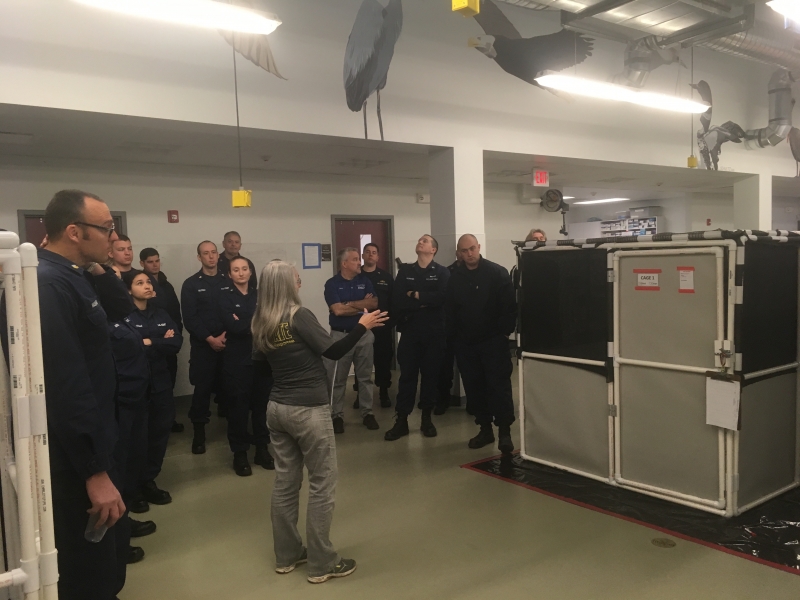
Oil Spill Response Coordinator, Danene Birtell, began the tour with an introduction to Tri-Country and its history, which dates back to Dec. 26, 1976, when the Liberian tanker Olympic Games ran aground in the Delaware River. Information technology was the sixth major oil spill in a iii-year period and despite the efforts of many people, thousands of animals died because little was known about helping oiled wild animals. Every bit a upshot, Tri-State Bird Rescue and Inquiry was founded in 1977 to report the effects of oil on birds and to detect a way to successfully treat wildlife.
Since its founding, the nonprofit has made great strides in the specialized fields of oiled wildlife responses and wildlife rehabilitation and has earned an international reputation, working together with manufacture, government agencies, colleagues, and a dedicated community of volunteers. Tri-Land has been responding to oil spills for more than than twoscore years and has provided oiled wildlife back up for such incidents as the M/V Treasure in South Africa, the mystery spill in San Mateo, California discovered to be caused by the Due south/S Jacob Luckenbach in California, the Athos I oil spill on the Delaware River, and Deepwater Horizon.
The arrangement'due south Wild Bird Dispensary is ane of the largest of its blazon in the United states of america, and handles the rehabilitation of birds not only from the region, but also from elsewhere inside the United states of america, with the aim of eventual release to the wild. The facility operates under federal and multiple state permits, and is staffed past both veterinary staff and volunteers. This clinic handles more than two grand birds annually and is currently housed within the Frink Eye for Wildlife. In improver to oil spill response and bird rehabilitation, the staff and organization also publish papers and journals, and provide workshops and training for chapter and local personnel from other organizations and agencies elsewhere. Fabricated up of experienced wildlife veterinarians, biologists, and oil spill response personnel with all-encompassing response experience and rehabilitation skills, Tri-State'south Oil Spill Response squad is on telephone call 24/7 to aid oiled wildlife forth the Delaware River, across the Us, and internationally.
In 2014, Tri-State opened a new building that is beyond the electric current state-of-the-art. At nearly 10,000 square feet, the Wildlife Response Annex "will let wildlife cleaning and handling on an unprecedented scale," said Danene Birtell, Oil Spill Response Coordinator. "It also has space to train responders, veterinarians and other rescue partners – and isolate sickened wild animals if necessary." With the exception of sea mammals and body of water turtles, the Annex is able to handle all kinds of birds and other wildlife from anywhere inside a five-hour drive according to Ms. Birtell.
The annex offers many special features to meet the needs of oiled wildlife and contains a total medical facility, in addition to the wash and part areas. The plumbing was designed to provide the consequent water force per unit area and temperature that the washing process requires. The unabridged floor of the wash area is grated with a drainage system below it. From the drainage organization, water is directed into underground waste tanks for removal.
As part of the tour, Tri-State veterinarians provided a first-hand demonstration of the process for cleaning oiled wild animals using a deceased Northern Gannet, 1 of the largest diving seabirds that lives in the Northward Atlantic. During the washing process, Tri-Land uses varying concentrations of dish detergent based on the sensitivity of the species and degree of oiling to remove oil from wild fauna. Once the patient has been done to remove contaminants, it is moved to the rinse area to remove all remaining rest from the wash process so that the animal'south waterproofing tin be restored. The rinse area, like the wash expanse, features grated floors with a drainage system. When patients make it, they are brought into the medical treatment room for a full examination and initial stabilization treatments. Later the patient has been washed and rinsed, information technology is so placed in the drying room adjacent to the rinse expanse. The flexible design of the room allows the staff to set up different types of dryers to meet each patient'due south needs. The addendum too contains a pathology lab where blood samples tin can be analyzed and necropsies performed. Close to the medical areas, a total kitchen and walk-in refrigerator/freezer unit consummate the treatment and rehabilitation areas of the annex.
Though the demonstration provided a closer wait at the work Tri-State does, I accept also seen first-hand the wonderful work and care that this organization provides during actual oil spill responses. Most recently, I worked with Tri-State during the May 2017 OCEANA jet-fuel spill that occurred in Virginia Beach, Virginia. Just about all of the NOAA Scientific Support Coordinators across the state accept worked with Tri-State during an oil spill response or training exercise.
Tri-State Bird Rescue & Research Inc. is located at 110 Possum Hollow Road, Newark, Delaware. For more data about Tri-State Bird Rescue & Research Inc., visit www.tristatebird.org.
Source: https://blog.response.restoration.noaa.gov/oiled-birds-and-dawn-dish-soap-behind-scenes-look-cleaning-and-rescuing-oiled-wildlife
Posted by: palacioscaved1966.blogspot.com
0 Response to "Does Dawn Actually Save Oil Covered Animals"
Post a Comment